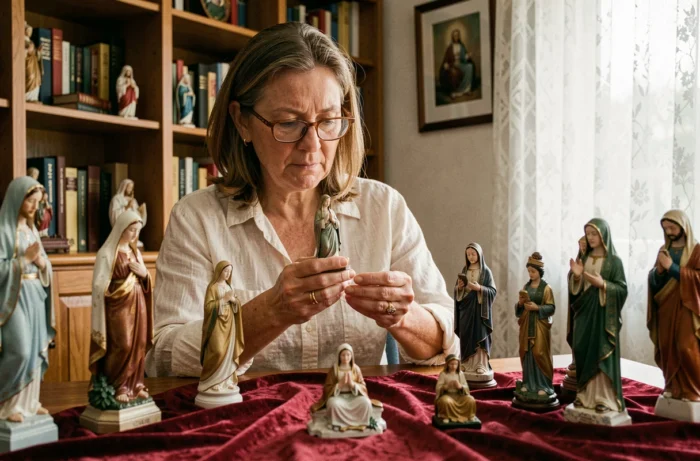
Hagietomamophilia refers to the collection of statues and figurines with religious significance. The term combines three Greek roots: hagios (holy), toma (section, cut object), and philia (attraction, taste for). Contrary to what its length might suggest, the word encompasses an ancient and well-documented practice in the world of sacred art collectors.
Hagietomamophilia and Agalmatophilia: Two Distinct Relationships with Statues
The confusion between these two terms often arises. Agalmatophilia pertains to sexuality: it is a paraphilia characterized by a sexual attraction to statues, dolls, or other similar objects. Its Greek etymology (agalma, statue, and philia, love) points to a clinical context.
Hagietomamophilia is not clinical at all. It belongs to the vocabulary of collecting, just like philately or numismatics. A hagietomamophile seeks out polychrome wooden Virgins, painted plaster saints, period crucifixes, or Provençal santons. The object interests them for its craftsmanship, iconography, rarity, or historical significance.
This distinction deserves to be clearly stated because search engines often mix the two subjects. Those searching for “passion for religious statues” frequently encounter results related to agalmatophilia, which muddles the understanding of a completely ordinary collecting practice. To discover hagietomamophilia on Sciences, Philo, Etc … in an encyclopedic context, the definition is treated without confusion.
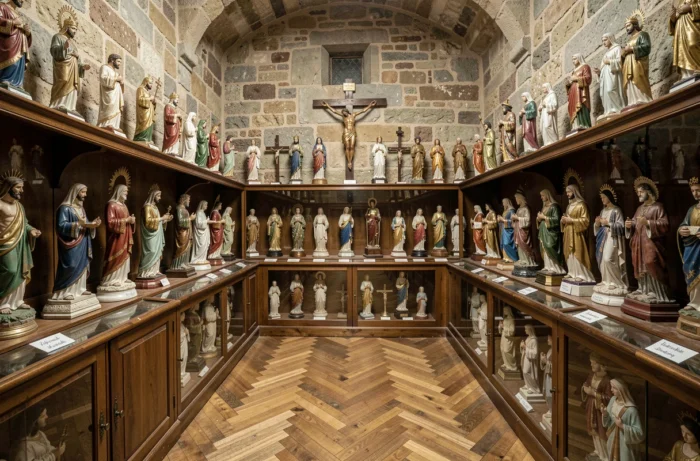
Religious Statues Collected: Typology and Value Criteria
The objects that interest hagietomamophiles cover a wide spectrum. Not all are equally valued in the sacred art market, and the evaluation criteria are not the same as those for a painting or a piece of furniture.
The Major Families of Objects
- Polychrome wooden statues from the medieval or Renaissance periods, often depicting the Virgin and Child or local saints, represent the most sought-after segment at auction houses. The carved wood, then hand-painted, retains traces of pigments that allow for dating the object and identifying the original workshop.
- Plaster figurines produced in series from the 19th century (Saint-Sulpice, Pieraccini, Catalan houses) form a more accessible segment. Their interest lies in the variety of models and their distribution in rural households.
- The Provençal santons, Neapolitan nativity scenes, and sculpted ex-votos form a distinct category, at the intersection of popular art and domestic devotion. Some 18th-century santon makers are now highly valued.
- Ivory, bronze, or precious wood crucifixes, sometimes commissioned by ecclesiastical orders, attract collectors interested in the craftsmanship of noble materials and documented provenance.
What Determines the Value of a Piece
Age matters, but provenance and condition often take precedence over date. A 17th-century gilded wooden Virgin, whose history can be traced back to an identified chapel, will be worth more than an older piece without documentation.
The original polychromy remains a determining criterion. Excessive restorations (industrial repainting, modern gilding) diminish a statue’s appeal to discerning collectors. Conversely, natural wear, traces of candle wax, or marks of liturgical handling authenticate the piece.
The subject represented also plays a role. Local patron saints, rarer than standardized Marian representations, generate particular interest in regions where their veneration has been documented.
Legal Framework and Market for Sacred Art Statues in France
Collecting ancient religious statues involves understanding certain legal constraints that sellers do not always mention.
Objects classified or listed as historical monuments cannot be sold freely. A statue from a church that is classified remains the property of the municipality or the state, even if it circulates in the market. Good faith buyers may find themselves compelled to return a piece purchased at a flea market or auction.
The legitimate market focuses on objects of private devotion (family oratories, domain chapels) and on pieces produced in series that have never been classified. Flea markets, religious antiques fairs, and specialized auctions constitute the main supply channels.
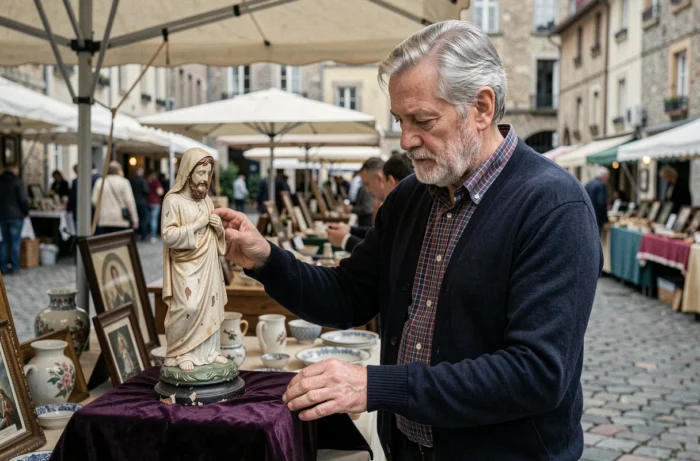
The online market has significantly broadened access to pieces, but it has also multiplied copies and fanciful attributions. Verifying authenticity before purchase remains the fundamental reflex of the experienced hagietomamophile, whether through direct expertise or by consulting a sacred art specialist.
Hagietomamophilia and the Preservation of Religious Heritage
The disaffection of many places of worship in France poses a concrete conservation problem. Thousands of statues leave closed, restructured, or looted churches each year. Collectors play an ambivalent role in this context.
On one hand, some hagietomamophiles save pieces destined for destruction or oblivion in presbytery attics. Their work in documentation, respectful restoration, and enhancement prolongs the life of objects that municipalities can no longer maintain.
On the other hand, market demand fuels thefts from still-active religious buildings. The trafficking of sacred art objects remains a documented phenomenon by specialized police services. The line between preservation and predation largely depends on the traceability of the pieces and the ethics of the buyer.
Hagietomamophilia, far from being a mere hobby for flea market enthusiasts, engages in reflection on the transmission of religious heritage. The next polychrome wooden statue encountered at a garage sale may carry three centuries of village devotion, and that is precisely what motivates collectors to preserve it.