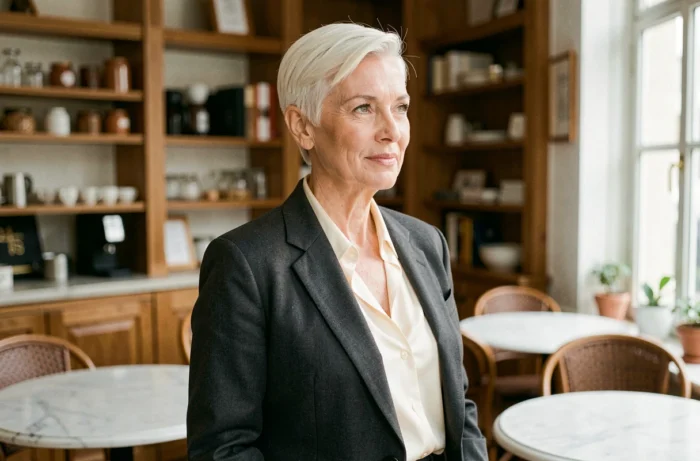
Choosing a haircut for white or gray hair in 2026 starts with understanding how the texture of non-pigmented hair alters the appearance of a hairstyle. White hair, lacking melanin, is often thicker, drier, and more resistant to styling than its colored counterpart. This technical parameter influences the choice of haircut as much as the shape of the face or personal style.
Texture of White Hair and Appearance Based on Haircut Type
White hair reflects light differently than pigmented hair. Where brown absorbs, white reflects, visually amplifying volume and apparent density. This optical property changes the game when comparing haircuts.
| Type of Haircut | Appearance on White Hair | Salon Maintenance | Required Texture |
|---|---|---|---|
| Textured Pixie | Maximum shine, luminous effect on the face | Every 4 to 6 weeks | Fine to medium |
| Deconstructed Bob | Natural volume, visible movement | Every 6 to 8 weeks | Medium to thick |
| Mid-Length Shag | Bohemian effect, softened layers by reflection | Every 8 to 10 weeks | Thick or wavy |
| Short Bob with Bangs | Sharp contrast, geometric structure | Every 5 to 7 weeks | Fine to medium |
| Long Layered Cut | Fluidity, but risk of flat effect if hair is fine | Every 8 to 12 weeks | Thick only |
The pixie and short bob make the most of the light reflection of white hair. Long cuts, on the other hand, require sufficient hair density to avoid the sparse look that light accentuates.
If you’re looking for a comprehensive overview of the trendy white haircuts for 2026, textured cuts and layers take center stage, and for good reason.

Grey Blending: The Technique Redefining White Haircuts
Grey blending is set to be the dominant technique in salons for 2026. Its principle: blend grey regrowth into the existing color rather than masking it. The result is a gradual gradient between pigmented areas and white areas, without a harsh line of demarcation.
This approach directly alters the choice of haircut. A successful grey blending works better on cuts with movement (shag, layered, tapered bob) than on straight and compact lines. The reason is simple: the color gradient needs moving strands to appear natural.
Why Grey Blending Changes Salon Visit Frequency
With traditional coloring, regrowth creates a harsh contrast after three to four weeks. Grey blending eliminates this issue since the regrowth is part of the design. The spacing between appointments can double compared to full coloring.
Ton-on-ton colorings often complement this technique. They offer partial and temporary coverage, useful when whites remain a minority. Their limit: they do not fully cover white hair and require regular renewal.
Textured Short Cuts for White Hair: Pixie and Bob Explained
The short cut remains a reliable choice for enhancing white hair. In 2026, two variations dominate.
The Textured Pixie
The pixie works particularly well on fine white hair. Texturization creates volume where white hair tends to lay flat. Hairdressers use texturizing shears or razors to break up uniformity and add dimension.
A pixie on white hair produces a very different luminous effect than the same pixie on brown hair. The reflection amplifies each cut strand, making the haircut more visible and graphic.
The Short Bob with or without Bangs
The short bob structures the face while maintaining enough length for styling variations. On white hair, bangs provide an interesting contrast by framing the forehead with a luminous mass.
- Straight bob without bangs: suitable for oval and long faces, modern and clean effect
- Layered bob with curtain bangs: softens angular features, works on medium-thick hair
- Asymmetrical bob: creates dynamism, ideal for breaking the monotony of uniform white
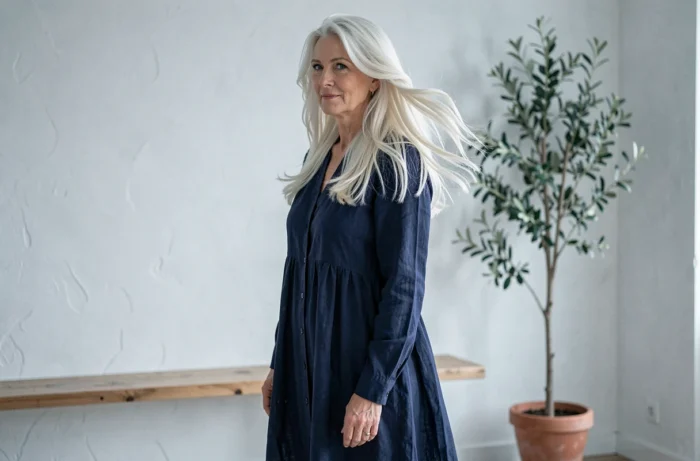
Mid-Length Cuts and Layers: What White Hair Requires
Layering on mid-length white hair follows specific constraints. Non-pigmented hair is often coarser and less pliable. A heavily marked layer can create dry and unruly ends instead of the desired fluid effect.
The modern shag with long layers works better than a short and tight layer. Long layers maintain the weight of the hair while creating movement. It’s the most effective compromise between volume and hold.
Maintaining Layers on White Hair
White hair yellows due to pollution, hard water, or styling product residue. Purple pigment shampoos have become a classic maintenance product, but excessive use can dry out the hair.
- Use purple shampoo once a week at most, not with every wash
- Alternate with a sulfate-free moisturizing shampoo to preserve flexibility
- Apply a leave-in treatment on the ends after each wash to limit straw-like effect
The choice of haircut and hair care routine are linked. A poorly maintained mid-length cut on white hair quickly loses its structured effect.
Face Shape and White Hair: Successful Combinations
The shape of the face remains the most reliable selection criterion. White hair amplifies volumes, altering the visual balance of the haircut in relation to the face.
A round face benefits from avoiding voluminous cuts on the sides. The pixie with volume on top or the tapered bob visually elongates. An elongated face, on the other hand, supports a bob with bangs that breaks the verticality.
Angular faces (square, rectangular) benefit from cuts with movement. The shag or deconstructed bob softens lines without erasing them. On white hair, this softening is enhanced by the natural brightness of non-pigmented hair.
The transition to white hair is a change in texture as much as in color. Adapting your haircut to this new hair reality produces a more coherent result than keeping the same hairstyle as before the transition. The trendiest haircut in 2026 is one that takes this technical reality into account.