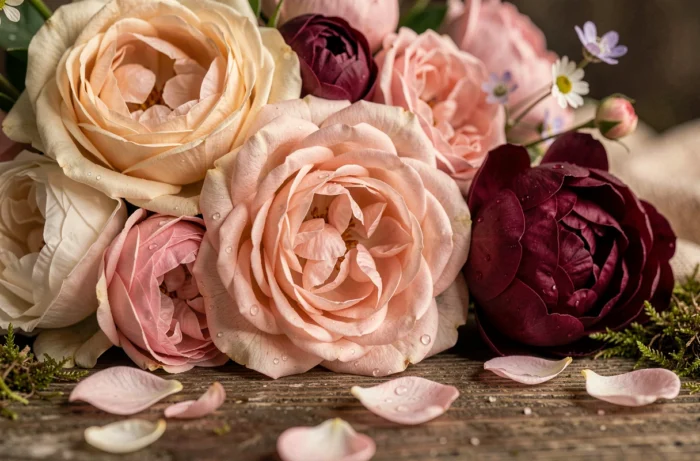
When preparing an event or simply trying to create a cohesive bouquet for a table, the first challenge is not the budget: it’s knowing which flowers are actually available in the right season and in the right shades. A complete floral catalog changes the game because it allows you to cross-reference varieties, blooming periods, and color palettes even before placing an order.
Seasonality of flowers: the criterion that most catalogs overlook
We have all ordered peonies in November only to find out they were out of season, imported from the other side of the world, and wilted within two days. A useful floral catalog does not just list names: it clearly indicates the availability period of each variety.
Roses and orchids are grown in greenhouses and are available almost year-round. Dahlias, delphiniums, or ranunculus follow a much stricter schedule. Confusing the two categories exposes you to inflated prices and poor vase life.
To explore varieties categorized by season and color, you can check the floral catalog of L’Herbe sous le Pied, which facilitates this identification work before purchase.
Imported cut flowers or French production: reading labels in 2026
The vast majority of cut flowers sold in France come from abroad. We are talking about considerable volumes transported by air or refrigerated truck from the Netherlands, Kenya, or Colombia. Several stakeholders in the industry advocate for making the share of local production visible.
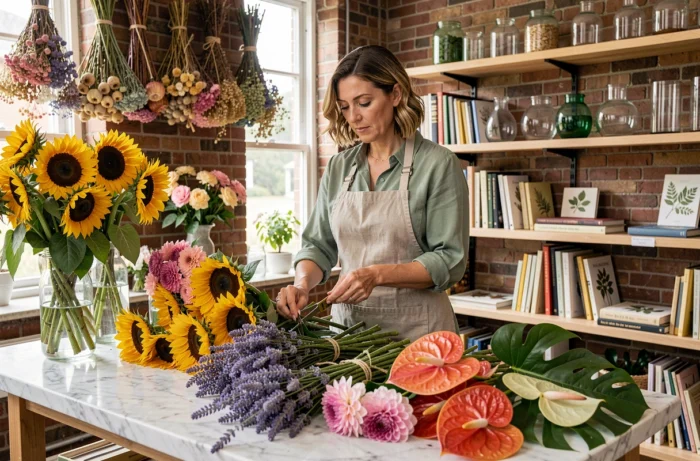
Open house events at floral farms and workshops are regularly organized across the country. It’s an opportunity to discover regional varieties that are not found in any standard online catalog.
Why provenance affects the lifespan of the bouquet
A local cut flower, harvested the day before or the morning of, retains a water reserve that imported flowers lose during refrigerated transport. Returns vary on this point depending on the varieties, but for fragile species (anemones, snapdragons, cosmos), the difference in longevity is striking.
Bouquet packaging: the new regulations post-AGEC law
Since September 1, 2026, non-compostable plastic films are banned at French florists. The implementing decree of the AGEC law now requires packaging in kraft paper, fabric, or certified home-compostable film, with a traceability obligation for materials in case of inspection.
This change has a direct impact on how one consults a floral catalog. Packaging is changing, and some bouquets previously offered in cellophane are now presented differently.
- Kraft paper properly protects short stems but does not withstand prolonged moisture during transport lasting several hours.
- Certified compostable films offer a comparable hold to the old plastic, with an additional cost that florists generally pass on to the final price.
- Fabric (jute, raw cotton) is well-suited for wildflower bouquets and dried arrangements, but less so for very hydrated bouquets.
Environmental claims on floral catalogs: what is prohibited
The European directive 2024/825, applicable from September 27, 2026, prohibits generic environmental claims on products and advertising. In practical terms, a floral catalog can no longer display terms like “ecological,” “green,” or “nature-friendly” without standardized evidence and a detailed public report on the life cycle.
Carbon neutrality based solely on compensation is also prohibited. For a buyer, this means that catalogs that continue to use these vague terms are either in violation or unreliable.
What this changes for choosing your flowers
You can now rely on labels that withstand this new regulatory framework. Certifications based on measurable criteria (absence of specific pesticides, short circuit with kilometer traceability, field cultivation without heating) are the only ones that hold up.
- Check if the catalog specifies the cultivation method (open field, cold greenhouse, heated greenhouse).
- Look for the mention of the country or region of production, not just the shipping location.
- Avoid catalogs that multiply self-awarded logos without reference to a third-party organization.
Floral art and the symbolism of flowers: beyond mere purchasing
A good catalog is not limited to selling. It also conveys the symbolism attached to the species. Orchids carry a connotation of refinement in most cultures. The white lily remains associated with ceremonies. Dahlias, long considered ordinary garden flowers, are experiencing a resurgence of interest since florists have incorporated them into contemporary arrangements.
Floral art is also evolving in its techniques. Structured bouquets in the European style coexist with more free approaches inspired by ikebana, where every stem counts and where emptiness is part of the composition. A complete floral catalog offers varieties that lend themselves to both approaches, from long-stemmed rigid flowers for classic arrangements to flexible branches for asymmetrical creations.
Choosing your flowers from a well-constructed catalog saves time on selection and avoids seasonal or longevity surprises. With the tightening of regulations in 2026 regarding packaging and environmental claims, the transparency of the catalog becomes an indicator of the supplier’s seriousness.