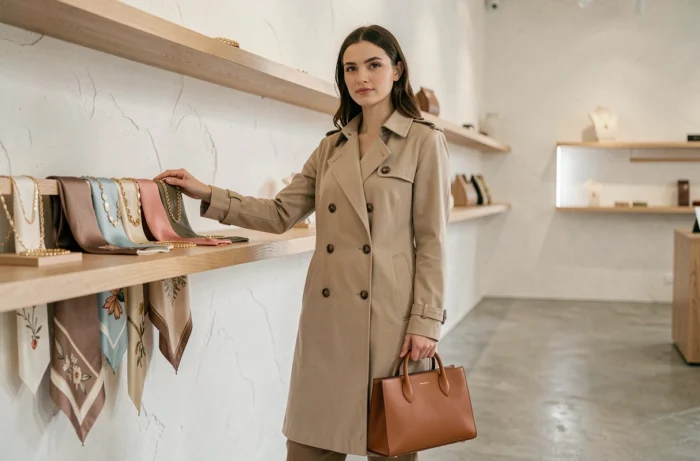
The fashion accessories market is undergoing a profound transformation. Between new European regulations reshaping brand offerings and evolving consumer expectations towards more sustainable pieces, the simple act of adding a scarf or a bag to an outfit now falls within a much broader context than just a style question. The trendy accessory of 2026 is no longer just pretty: it carries a story, traceability, and sometimes even a digital passport.
European Regulation and Fashion Accessories: What Changes in 2026
As of July 19, 2026, large companies operating in the European Union market are no longer allowed to destroy their unsold clothing accessories. Bags, scarves, hats, belts: everything is affected. This ban stems from the Regulation (EU) 2024/1781 on the Ecodesign of Sustainable Products (ESPR), whose application in the clothing and accessories sector directly targets large structures.
Exceptions remain tightly regulated: hazardous products, proven counterfeits, technical impossibility of donation. Outside of these cases, dormant stocks must be directed towards second-hand, outlet, or donation.
This regulatory constraint pushes brands to rethink their production volumes. Rather than betting on overly abundant collections, several brands are reducing the number of references and extending the commercial lifespan of each piece. For buyers, this translates into more streamlined accessory collections, with pieces designed to last several seasons rather than just a few weeks.
At the same time, the ESPR introduces the Digital Product Passport (DPP), a digital sheet attached to each textile and accessory product. This passport will provide information on the exact composition, the origin of materials, manufacturing conditions, and recycling instructions. Accessories made of leather, mixed fibers, or containing metal elements will be particularly affected, as their traceability poses specific technical challenges.
Among all the accessories from Camille Un Point C’est Tout, there are pieces that align with this logic of sustainability and thoughtful choices, far from disposable collections.

Scarf, Belt, and Clutch: The Pieces That Transform an Outfit
Not all accessories have the same power to transform a look. Some act as mere complements. Others radically change the silhouette or intention of an outfit.
The Scarf as an Architectural Piece
The scarf is no longer limited to a square tied around the shoulders. Worn as a belt on a flowing dress, as a headband in the hair, or twisted around the handle of a bag, it multiplies uses without multiplying purchases. A single well-chosen scarf replaces three different accessories.
Natural materials dominate current choices: silk, cotton, linen. This shift towards non-synthetic fibers responds to both ecological sensitivity and real comfort, especially in summer.
The Belt as a Structural Tool
On high-waisted pants, a leather belt defines the silhouette. On an oversized jacket worn open, it creates a visual tension point that adds controlled volume. The belt remains one of the most underutilized accessories in a daily wardrobe, even though it completely changes the perception of an outfit.
Models with discreet buckles and soft leather adapt better to everyday looks than ostentatious logo versions, whose relevance heavily depends on the context.
The Clutch as an Alternative to the Crossbody Bag
The crossbody bag maintains its place in daily commutes due to its practicality. However, for a dinner, an outing, or an event, the clutch imposes a minimalism that immediately elevates the outfit. Choosing between the two comes down to choosing between pure functionality and stylistic intention.
Stainless Steel Jewelry and Sustainable Accessories: Beyond the Trend
Stainless steel jewelry is increasingly prominent in accessory collections. Rings, necklaces, earrings: these pieces resist oxidation, do not tarnish when in contact with water, and maintain their shine over time. Their manufacturing cost, lower than that of precious metals, allows for accessible prices without sacrificing durability.
This positioning corresponds to a specific expectation: jewelry worn every day without special care. Field feedback varies on this point depending on the alloys used, with some lower-quality steels showing a greater sensitivity to scratches than others.
Here are a few criteria to check before buying stainless steel jewelry for daily use:
- The mention “316L stainless steel” or “surgical steel,” which guarantees better corrosion resistance than standard steels
- The absence of superficial plating (gold or silver) that flakes off after a few weeks of regular wear
- The closure system, especially on earrings and necklaces, which determines daily comfort as well as sturdiness
Trendy Accessories and Everyday Style: Choose Less but Better
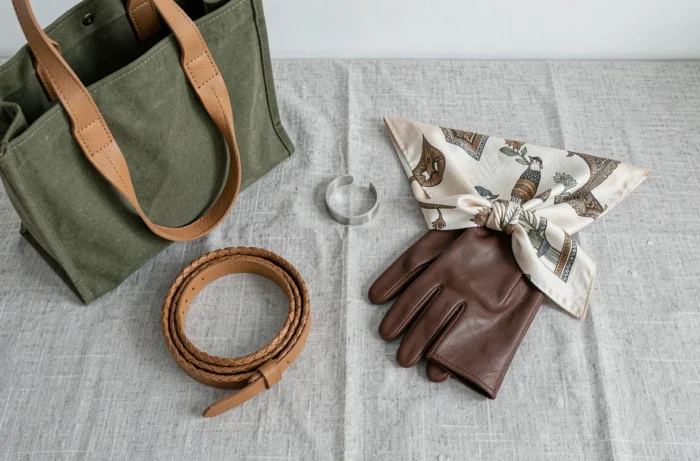
The accumulation of cheap accessories often produces the opposite effect of what is sought. Three or four well-chosen pieces, coherent with each other and suited to the body shape, yield a more defined result than a dozen mismatched pieces.
The principle of an accessory capsule works like that of a capsule wardrobe:
- A structured bag in a neutral color (black, camel, taupe) that pairs with most outfits
- A patterned or brightly colored scarf to add contrast without changing clothes
- A pair of discreet earrings for everyday wear and a more substantial pair for special occasions
- A high-quality leather belt that ages well rather than cracking after a season
Four accessories are enough to cover most dressing situations, from the office to the weekend. The challenge is not to have more, but to have just enough.
With the implementation of new European requirements on traceability and sustainability, this selective approach is no longer just an aesthetic choice. It aligns with a market that, due to regulations, is moving towards pieces designed to last. The trendy accessory of 2026 is one that will still be worn in 2028.