
We connect the new battery, turn the key, and the engine starts. Everything seems normal until the idle starts to oscillate strangely, the driver’s window refuses to go up automatically, or a check engine light stays on for no apparent reason.
Resetting your car after a battery replacement is not just about reconnecting two terminals. Several electronic systems lose their settings as soon as the power is cut, and each requires a specific procedure to return to normal operation.
Battery Management System: the reset that no one does
Online guides often mention setting the clock or retrieving the radio code. A more technical point is overlooked: on most modern vehicles, the ECU integrates a Battery Management System (BMS) that records the age, capacity, and type of battery installed. When a new battery is installed without informing the BMS, the system continues to manage the charge as if the old battery were still in place.
The concrete result: the alternator adjusts its charge voltage to the characteristics of the old battery, which can undercharge or overcharge the new one. On some models, this significantly reduces the battery’s lifespan. As detailed in recent articles on blogautomobile.net, this battery coding step has become as necessary as tightening the terminals.
To perform this BMS reset, a diagnostic tool (like OBD2 with battery function) is generally required. Ford, BMW, or Volkswagen document specific procedures in their technical manuals. No universal manual method replaces a diagnostic tool for this operation, even if some forums suggest otherwise.
Maintaining power during battery replacement
It is often thought that the reset occurs after the change. In reality, the best strategy starts before disconnecting the old battery. On many modern models, a complete power cut can cause settings to be lost in just 10 to 30 seconds.
The solution: connect an auxiliary power supply (improver, 9V battery with OBD adapter, or maintainer charger) before removing the old battery. This precaution preserves the settings of the engine management system, window positions, seat memory, and radio code.
Suitable equipment
- An OBD2 maintainer cable powered by an external battery or a small lithium improver, which plugs into the vehicle’s diagnostic port and keeps the ECUs powered
- An intelligent charger plugged into the mains, connected to the vehicle’s terminals with crocodile clips while the battery is removed
- In an emergency, a simple starter improver connected to the car’s cables with the battery still in place, disconnected after installing the new one
With this method, the number of resets needed afterward is significantly reduced. Feedback on this point varies by brand, but the logic remains the same: less power cut, fewer settings lost.
Resetting electric windows and steering wheel
When power has been cut without maintenance, two systems pose immediate problems in daily use: electric windows and power steering.
Electric windows: recalibrating the full travel
After a battery cut, the automatic function (up/down with one press) no longer works. The ECU has lost the upper and lower position of each window. The procedure is simple but must be done window by window:
Lower the window completely while holding the button down, then hold it for another two to three seconds at the bottom. Next, raise the window completely and hold the button for two to three seconds at the top. Repeat the operation for each window in the vehicle. On some models (Peugeot, Renault), you need to turn off the ignition and turn it back on between each window.
Electric power steering
After a battery change, the power steering system may feel stiffer or less precise. The recalibration is done by turning the steering wheel from stop to stop (left then right, or vice versa), engine running, vehicle stationary. One or two full cycles are enough for the ECU to regain its reference points.
Warning lights and fault codes after a battery change
A check engine light, an airbag warning, or a stability system fault message that stays on after the battery replacement: this is common and not necessarily serious. The power cut generates temporary fault codes in the ECUs. The vehicle has detected an anomaly (the loss of voltage) and has recorded it.
In many cases, driving for about twenty minutes under normal conditions is enough for the ECUs to automatically clear these faults. The engine management system needs several driving cycles to validate that everything is working correctly with the new battery.
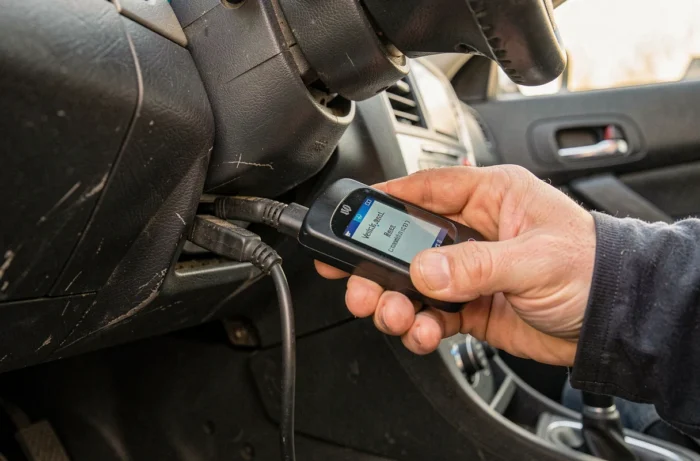
If a warning light persists after a few trips, a basic OBD2 reader (available for a few dozen euros) allows you to read and clear the fault codes. Caution: clearing a code without understanding its cause masks a real problem. Only clear codes clearly related to the battery cut (under-voltage, temporary communication loss), not a sensor or probe fault.
Unstable idle and throttle learning
The idle that rises and falls on its own during the first kilometers after a battery change is the engine ECU losing its throttle adaptation values. The motorized throttle body needs to relearn its resting position and idle corrections.
The procedure varies by manufacturer, but the principle remains the same: turn on the ignition without starting, wait a few seconds, then start and let the engine idle without touching the accelerator for several minutes. Do not turn on the air conditioning or headlights during this phase. The ECU gradually recalibrates the air flow at idle.
On models equipped with a Start-Stop system, it may remain disabled until the BMS has validated the charge state of the new battery. This can take several driving cycles before the function reactivates itself.
Replacing a car battery now goes well beyond mechanics. Between BMS coding, recalibrating the openings, and readjusting the idle, each vehicle requires a specific re-commissioning sequence. Keeping the manufacturer’s manual handy and having a diagnostic reader, even a basic one, saves considerable time compared to trial-and-error attempts.