
A centralized locking system that no longer responds disrupts daily life: stubborn door, silent trunk, vehicle impossible to secure. The problem does not always come from where we think. On recent vehicles, the classic failure of a battery or fuse is gradually being replaced by software malfunctions related to the embedded control module. Understanding the failure chain, from the radio signal to the mechanical actuator, allows for intervention in the right place without unnecessarily replacing parts.
Body Control Module: the invisible failure of the centralized locking system
The majority of troubleshooting articles immediately point to the remote control battery or the circuit fuse. These checks remain relevant, but they mask a technical reality that is gaining ground on vehicles produced in recent years.
The Body Control Module (BCM) centralizes the management of openings, interior lighting, and the alarm. When this module loses synchronization with the remote control or suffers a software bug, all doors can remain locked (or unlocked) without any mechanical component being at fault.
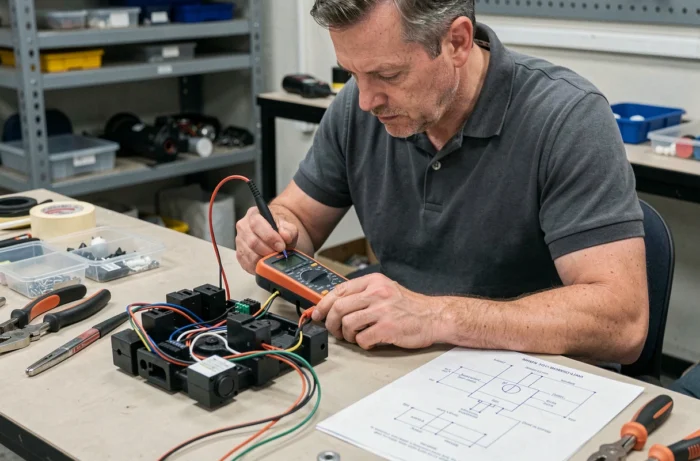
Identifying a BCM problem requires a diagnostic tool capable of reading fault codes from the multiplexed network. A simple multimeter is not sufficient. Manufacturers document specific reset procedures for each model, often accessible from the ignition key combination and the lock button. If you are considering repairing with Serrurier Dic, this software step is part of the initial diagnosis before any hardware intervention.
A common trap: replacing a door actuator when the BCM no longer transmits the command. The new part will not change the problem.

Methodical diagnosis of a faulty centralized locking system
Before disassembling anything, a diagnostic by elimination avoids wasting time and money. The operation chain always follows the same order: remote control, radio signal, control unit, electrical harness, actuator, mechanical lock.
Remote control and signal reception
Test the remote control by observing if the key light turns on when pressed. If nothing happens, the battery is likely at fault. If the light works but the vehicle does not respond, the problem lies downstream: radio receiver or loss of synchronization with the BCM.
A simple test involves using the physical key in the driver’s lock. If manual locking works and triggers the central locking of the other doors, the electrical circuit is operational. The fault is then limited to the wireless signal.
Electrical circuit and fuses
The fuse dedicated to central locking is usually found in the passenger compartment fuse box. Its location varies by manufacturer, but the vehicle manual identifies it by a padlock pictogram or the mention “LOCK”.
- A blown fuse that is replaced and does not blow again indicates a one-time incident, often related to a temporary overload.
- A fuse that blows again immediately after replacement signals a short circuit in the wiring harness, common at door passes where the wires undergo repeated flexing.
- An intact fuse with an inert system points to the control unit or the BCM.
Actuators and mechanical locks
When a single door refuses to respond while the others function normally, the actuator of that door is the main suspect. This small electric motor wears mechanically over time. Sometimes a humming sound is heard without the lock moving, indicating that the motor is running idle.
The jamming of the mechanical lock complicates the diagnosis. In cold weather, frost can block the mechanism regardless of any electrical fault. A lock de-icer applied in the cylinder helps distinguish a thermal blockage from a real failure.
Connected centralized locking: the issue of cybersecurity
Locking systems are evolving towards advanced wireless technologies: Bluetooth, NFC, mobile app unlocking. This connectivity opens an angle that traditional troubleshooting does not address.
In Europe, regulatory requirements surrounding the cybersecurity of connected products are tightening. The Cyber Resilience Act requires manufacturers to ensure the software security of their components throughout their lifecycle. For a vehicle owner equipped with a connected locking system, this means that software updates for the locking system become as critical as mechanical maintenance.
A vehicle whose locking firmware has not been updated may present exploitable vulnerabilities, as well as functional bugs. Some central locking failures on recent models can be resolved with a simple software update at the dealership, without any physical intervention.
Field feedback varies on this point: not all after-sales networks yet systematically offer software diagnostics before replacing parts. Checking with the manufacturer if a software fix exists for your model can avoid a bill for actuator replacement.
Tools and limits of troubleshooting without a garage
Some interventions remain accessible without professional equipment, while others require a mandatory visit to the workshop.
- Replacing the remote control battery: doable in a few minutes with a flat screwdriver, without special skills.
- Checking and replacing a fuse: accessible as long as the correct fuse is identified in the vehicle documentation.
- Resetting the remote control: the procedure varies by brand, generally involving a sequence of ignition and button presses on the key.
- Replacing a door actuator: requires disassembling the trim panel, knowledge of cable routing, and an actuator compatible with the exact model.
- BCM diagnosis or reprogramming: requires a professional diagnostic tool capable of communicating with the vehicle’s CAN network.
The boundary between DIY troubleshooting and professional intervention lies precisely at the level of electronic diagnosis. As long as the failure concerns an identifiable physical element (battery, fuse, jammed lock), the intervention remains within reach. As soon as the system shows no visible faults but refuses to operate, using a fault code reading tool becomes the only reliable option.
One last often-overlooked point: on vehicles equipped with a peripheral alarm, a clumsy troubleshooting attempt (prolonged battery disconnection, manipulating the BCM without procedure) can trigger an anti-theft lock that complicates the situation further. Consulting the manufacturer documentation before any manipulation remains the most cost-effective reflex.