
When looking for a pair of cork-soled sandals for summer, the instinct is often to check out Birkenstock. The problem is the price, or sometimes simply the desire to vary. Several brands today offer models with comparable comfort, with choices of materials and styles that deserve attention.
PFAS Regulation and Shoes: What Changes for Sandals in 2026
Before discussing models, a technical point often overlooked in comparisons. Starting January 1, 2026, French law prohibits the use of PFAS (per- and polyfluoroalkyl substances) in the manufacturing of any shoes intended for consumers. PFAS are used, among other things, for waterproofing treatments and certain adhesives.
In practical terms, any brand selling sandals in France will need to prove its compliance before hitting the market. Birkenstock and its competitors are affected. For us buyers, this means that brands that have already begun a transition to PFAS-free materials are getting ahead. This will be an increasingly important selection criterion in the coming months.
Among the brands equivalent to Birkenstock, several are already communicating about abandoning these substances, while others remain vague on the subject.
Cork Sole, Molded Sole: The Real Comfort Criterion of a Sandal
What gives Birkenstock its reputation is its anatomical sole made of cork and natural latex. Cheap copies replicate the shape, but rarely the feel. When you slip on a pair for less than 35 euros on Amazon (like Cushionaire), the arch support flattens after a few weeks. It’s fine for occasional use, but not for walking all day.
Brands that truly come close to Birkenstock comfort use different but comparable processes:
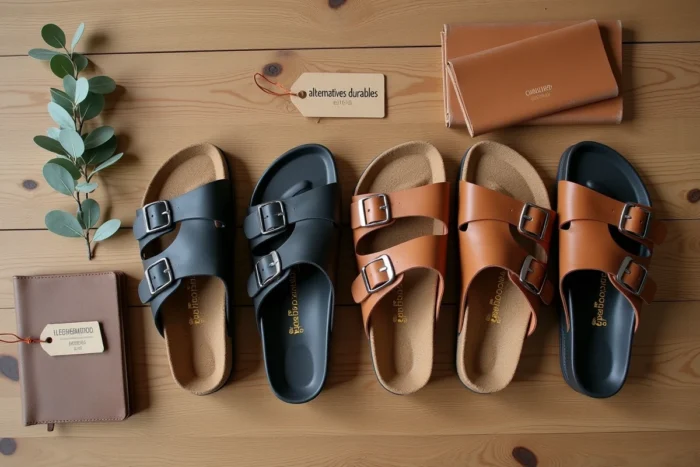
- Natural compressed cork sole with a layer of latex, as seen in some German or Scandinavian brands that make their own cork blocks.
- Molded dense EVA sole with a marked anatomical shape, an approach found in outdoor or sports-oriented brands.
- Recycled cork sole combined with natural rubber, a choice adopted by several brands positioned in the eco-friendly segment.
Feedback varies on this point, as the perception of comfort also depends on the weight of the wearer and the shape of the foot. A natural cork sole gradually molds to the foot, which is not the case with an EVA sole, even a high-end one.
Birkenstock Alternatives in Leather, Vegan, or Textile: How to Choose
Smooth or nubuck leather remains the most common material for models like Arizona or Boston. For those avoiding leather, the range has significantly expanded. Credible vegan alternatives use textured microfiber, not low-quality PVC that causes sweating.
Full Grain Leather Sandals
They can be found at European brands that work with vegetable-tanned leather. Prices are generally above Amazon dupes but below Birkenstock. Full grain leather ages better and doesn’t peel after a summer.
Vegan Models and Recycled Materials
Several eco-friendly brands offer two-strap sandals with uppers made from synthetic materials certified as free from toxic solvents. This is a rapidly growing segment, driven by a demand for transparency regarding components. With the PFAS ban in 2026, vegan brands that do not use fluorinated treatments will have a regulatory advantage.
Decathlon and Birkenstock-Type Sandals: A Price-Quality Ratio to Examine
Decathlon frequently comes up in discussions about alternatives to Birkenstock. The store offers models of mules and sandals with anatomical soles at very low prices. Several French media outlets have reported these models as credible substitutes for summer 2026.
The strong point is accessibility: you can try them in-store, easily return them, and the entry price remains a fraction of that of a Birkenstock Arizona. The weak point is durability. Decathlon soles are generally made of injected EVA foam, not cork. Comfort is immediate, but longevity is inferior to a cork sole that densifies with use.
For daily use over a summer, it’s a reasonable choice. For someone wanting to keep their sandals for several seasons, one would lean towards brands that invest in cork or natural rubber.
Concrete Criteria for Evaluating a Brand Against Birkenstock
Rather than a list of brands that will be outdated in six months, here’s what to check before buying:
- Type of sole (natural cork, recycled cork, EVA, rubber) and thickness of arch support.
- Material of the strap (full grain leather, certified vegan microfiber, unspecified synthetic) and type of buckle (metal, plastic).
- Place of manufacture and transparency regarding chemical treatments, especially with the upcoming PFAS regulation in 2026.
- Resoling or repair policy, a reliable indicator of the confidence a brand has in its own product.
Birkenstock sandals remain a reference because the brand has ticked most of these boxes for a long time. The interesting alternatives in 2025 are those that meet at least three of these four criteria, without merely reproducing the look at a lower cost.
The market for anatomical sandals is moving quickly. Brands that anticipate the PFAS regulation and invest in sustainable materials are those that will hold up against Birkenstock beyond just one season.