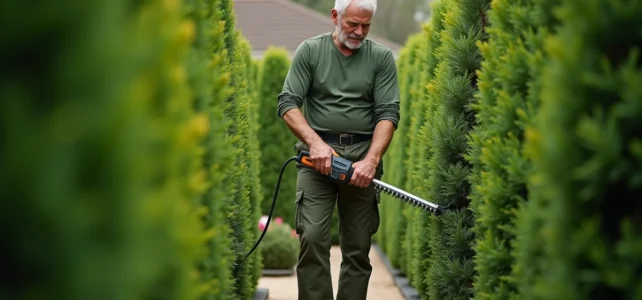
Between a young thuja trimmed every year and a mature hedge left untouched for two seasons, the mechanical constraints imposed on a hedge trimmer are incomparable. The actual diameter of the branches, the density of the foliage, and the height of the hedge determine the type of machine capable of producing a clean cut without stalling. Therefore, choosing a hedge trimmer for thujas involves crossing three measurable technical parameters with the actual condition of your hedge.
Tooth spacing, blade length, and voltage: the data to compare
Product sheets multiply the figures, but not all have the same weight when it comes to trimming thujas. The table below summarizes the three discriminating criteria according to the hedge profile.
| Hedge Profile | Recommended Tooth Spacing | Blade Length | Power Source |
|---|---|---|---|
| Young thujas, trimmed every year | 16-18 mm | 45-50 cm | Corded electric (400-700 W) or 18 V battery |
| Thujas aged 5 to 8 years, regular maintenance | 22-24 mm | 50-55 cm | 18 V or 36 V battery |
| Mature or poorly maintained thujas | 26-28 mm | 55-60 cm | 36 V battery or gas-powered |
| Tall hedge (above arm height) | 22-28 mm | Telescopic pole | 36 V battery or gas-powered |
The tooth spacing sets the maximum branch diameter that the machine can cut without straining. Choosing a hedge trimmer suitable for thujas requires measuring the thickest branches in advance and adding a few millimeters of margin to avoid jams.
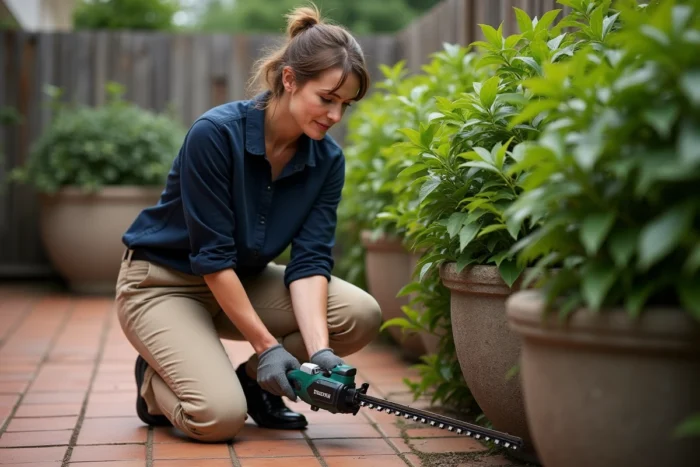
Tooth spacing and actual condition of the hedge: the most underestimated criterion
Most guides associate a tooth spacing with a plant species. The thuja, for example, is assigned a standard spacing. This approach overlooks a decisive parameter: the state of maintenance changes everything.
A thuja trimmed twice a year produces fine shoots, rarely exceeding the lower limit of modest spacing. The same thuja left untrimmed for two years develops significantly thicker lignified branches, which require a larger spacing.
In practice, measuring the branches with a simple tape measure or caliper before purchase allows for a clear decision. Too tight a spacing causes repeated stalls, damages the motor, and leaves ragged cuts that turn brown within days.
Hedge trimmer on a pole for tall thujas: when the classic tool is no longer sufficient
As soon as the hedge exceeds arm height, a classic hedge trimmer requires working on a ladder. The risk of falling increases, fatigue sets in more quickly, and the consistency of the cut suffers.
A pole hedge trimmer allows you to reach the top from the ground. Eliminating the ladder reduces the risk of falling, making it a more relevant choice than a standard model for tall hedges. The compromise lies in weight and maneuverability: a pole tool weighs more and requires an adjustment period to achieve a straight cutting line.
For hedges exceeding two meters while remaining accessible from above, a 36 V battery-powered telescopic pole offers a good balance between autonomy and cutting power.
Trapezoidal trimming of thujas: a parameter that influences blade choice
Trimming a thuja hedge perfectly straight on the sides seems logical. However, the ideal shape is slightly trapezoidal: wider at the base, narrower at the top. This geometry ensures that light reaches the lower branches, preventing the gradual thinning of the base of the hedge.
The annual reduction in width should not exceed 5 to 10 cm to avoid cutting into the inner dead wood, which cannot regenerate green shoots. A thuja trimmed too severely reveals permanent brown holes.
This constraint has a direct consequence on the equipment: a blade of 50 to 55 cm facilitates angled work on the sides, where a very long blade becomes cumbersome for following an oblique angle. Shorter blades also offer more precision for delicate passages near the base.
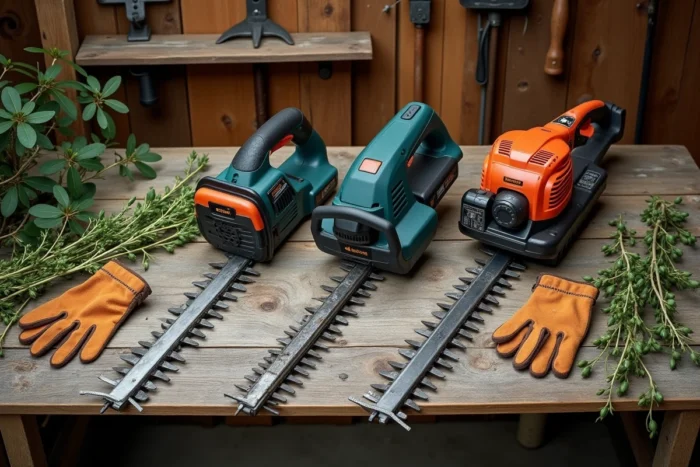
Trimming period and nesting: a constraint to consider before investing
The choice of hedge trimmer is not limited to the machine. The usage window also matters. Between March 16 and July 31, significant trimming should be avoided due to the bird nesting period. Only light interventions or safety imperatives justify cutting during this window.
This seasonal restriction has a practical impact: if you can only trim in late summer or autumn, the regrowth accumulated since spring will be denser. A hedge trimmer sized for annual shoots may find itself underpowered against several months of uncontrolled growth.
Here are the points to check before finalizing your choice:
- Measure the diameter of the thickest branches and add a safety margin to determine the minimum tooth spacing
- Evaluate the height of your hedge: beyond arm height, a pole model avoids the use of a ladder
- Identify your actual trimming window (excluding the nesting period) to anticipate the thickness of the regrowth to be cut
- Check the weight of the device when loaded, including the battery, especially if your hedge is over twenty meters long
The right hedge trimmer for thujas is not the most powerful in the catalog. It is the one whose tooth spacing matches the actual branches of your hedge, whose blade length allows for a trapezoidal cut, and whose format (classic or pole) adapts to the height without compromising your safety. A well-sized tool cuts cleanly on the first pass, where an undersized model tears and browns the foliage.