
At the counter of a Marseille café, one does not order a “pastis grenadine.” One asks for “a tomato.” This ordering code, shared from Toulon to Avignon, encapsulates the place this mixture holds in the counter culture of southern France. Behind this familiar name lies a cocktail whose construction is more rooted in the history of French pastis than one might often think.
The Provençal counter vocabulary: a code before being a recipe
The tomato was not born in a cocktail book. It has established itself in the cafés of Provence as a codified order, just like the parrot (pastis and mint syrup) or the mauresque (pastis and orgeat). These short names function as a parallel language between the customer and the server.
This system of codes reflects a hierarchy of variants that structures the unwritten menu of southern cafés. The history of Ricard tomato can be found in this oral tradition passed from terrace to terrace, long before culinary blogs took it up.
What distinguishes the tomato from other variants is its color. The bright red of the grenadine syrup, mixed with the milky cloudiness of the diluted pastis, produces an orange to deep red hue. The visual analogy with the fruit is immediate, and it is this that gave the mixture its name, not any tomato-based ingredient.

Ricard tomato and the competition among pastis brands: a commercial specialization
People commonly refer to “Ricard tomato,” but the recipe works with any pastis. The association of the name Ricard with this cocktail is more about a brand usage that has become generic than an exclusive recipe. It’s the same linguistic phenomenon that leads people to say “a Frigidaire” for a refrigerator.
Ricard and Pastis 51 (two brands now united under the Pernod Ricard group) have built their notoriety in parallel, each claiming a share of the culture of French aniseed pastis. The tomato belongs to this shared heritage. Its specialization under the “Ricard” label is more due to this brand’s commercial dominance in cafés than to a difference in recipe.
Opinions vary on this point among enthusiasts: some find that the aromatic profile of Ricard (more pronounced in licorice) pairs better with grenadine than that of Pastis 51 (more oriented towards anise). In practice, the quality of the grenadine syrup used weighs as much as the choice of pastis.
The dosage of the tomato: what happens between the syrup and the water
The preparation of a tomato relies on a precise sequence that conditions both the taste and the visual aspect of the glass. Here are the steps as observed at the counter:
- First, pour the grenadine syrup into the bottom of the glass (a generous splash, not a timid drop), which establishes the sweet and colorful base of the mixture.
- Next, add a dose of pastis, which rests on the syrup without immediately mixing, creating a gradient of color.
- Add fresh water, which triggers the characteristic cloudiness (the “louchissement”) related to the essential oils of anise that become insoluble when in contact with water.
- Stir lightly to homogenize, or let the customer do it, depending on local customs.
The order of addition truly changes the visual result. Pouring the pastis first and then the grenadine produces a more uniform mixture but less spectacular. The red-orange gradient that is the signature of the tomato requires the syrup to be placed first.
The question of louchissement
The cloudiness that appears when water is added is not decorative. It is a physicochemical reaction: the anethole compounds present in pastis are soluble in alcohol but not in water. By diluting, an emulsion of micro-droplets is created that diffuse light and give that opalescent appearance.
In a tomato, this reaction interacts with the color of the grenadine. The red of the syrup turns into a cloudy orange, which reinforces the analogy with a ripe tomato. The temperature of the water also plays a role: very cold water accentuates the cloudiness, while warm water makes it less pronounced.
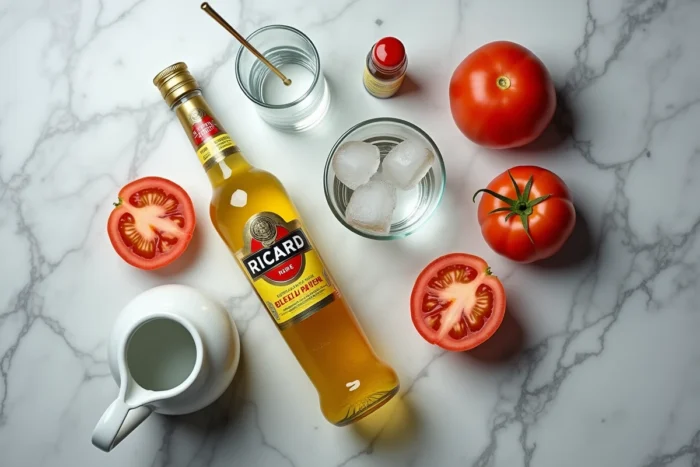
Industrial or artisanal grenadine: the ingredient that changes everything
The role of the syrup in the success of a tomato is often underestimated. Standard industrial grenadine mainly contains sugar, artificial flavors, and colorings. Its taste is sweet but one-dimensional.
An artisanal grenadine, made from pomegranate juice, brings a natural acidity that balances the bitterness of the anise. The difference in the mouth is striking: the cocktail gains complexity and loses that sweet drink sensation that can be cloying after the second glass.
To test the difference, one can prepare two identical glasses with only the syrup changed. The visual contrast is also noticeable: artisanal grenadine produces a darker red, almost garnet, while the industrial version leans towards bright artificial red.
Related variants to know
The tomato is part of a trilogy of Provençal counter cocktails that share the same base:
- The parrot replaces grenadine with mint syrup, resulting in a green color and a fresher, minty profile.
- The mauresque uses orgeat syrup (almond), for a sweeter, almost milky result, with notes of sweet almond.
- The cornichon, less known, combines mint and grenadine in the same glass of pastis, for a more complex and divisive mixture.
These four variants form the foundation of the informal menu of arranged pastis found in southern cafés. Each carries a short order name, recognized without explanation by any server in the region.
The tomato remains the most ordered of these variants, probably because the sweetness of the grenadine softens the anise without masking it. It serves as an entry point to pastis for those who are put off by pure anise bitterness. This also explains its longevity: for decades, it has continued to be the first arranged pastis ordered on the terrace when the sun is shining.