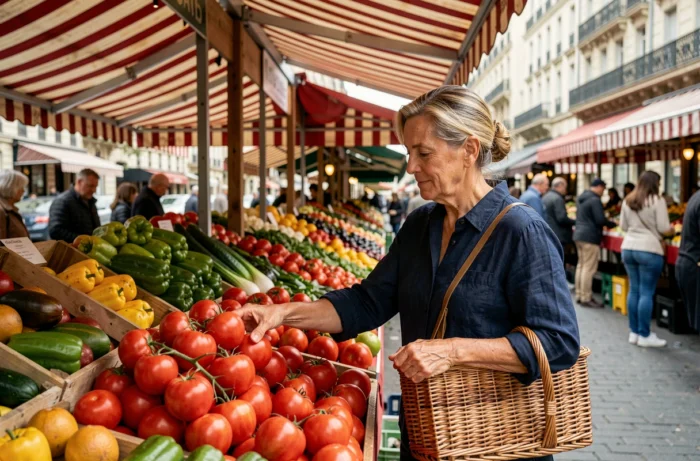
When looking for flavorful tomatoes in the middle of June in Paris, the instinct is not to open a delivery app. You head to the market. The problem is that the capital has over 80 food markets, with varying quality levels from one stall to another. Not all stalls are equal, and being at an outdoor market does not guarantee direct sales or local sourcing of products.
Selection of sellers at Parisian markets: what the City really controls
Before discussing a specific market, it’s essential to understand how a vendor secures their spot. The City of Paris distinguishes several categories: regular vendors, producers, and sellers offering products from sustainable food sources. Producers must provide a certificate attesting to their quality, and organic sellers a certificate issued by an accredited organization.
This administrative selection goes beyond a simple right to operate. When a seller uses an intermediary or wholesaler, the City requires documentation to verify the origin of the products. A detailed guide can be found on Paris Tribu about Parisian markets to identify stalls that clearly display their sourcing methods.
In practice, management relies on a public service delegation. The concessionaires operating the markets do not just rent spaces: they install equipment, organize vendor placements, and manage waste collection. This system explains why two markets located just a few districts apart can offer a very different experience in terms of diversity and freshness.
Fresh products in Paris: distinguishing a producer from a reseller at a market
We are often asked: how can you tell if the greengrocer is selling their own vegetables or those bought at Rungis that very morning? A producer’s stall usually displays the production location (town, department), sometimes with photos of the farm. A reseller, on the other hand, offers a broader range, including exotic or out-of-season fruits that do not grow in Île-de-France.
Here are some concrete clues to differentiate:
- The limited variety of the stall: a producer rarely cultivates more than twenty different items, compared to fifty or more for a wholesaler
- The appearance of the vegetables: irregular sizes, dirt still present on carrots or leeks, untrimmed foliage
- The seller’s ability to discuss their cultivation methods, crop rotations, or harvest dates
Feedback varies on this point, as some resellers know their suppliers very well and offer quality products. The goal is not to demonize reselling, but to know what you are buying.
Covered markets or outdoor markets: how the format changes the products
Paris has permanent covered markets and outdoor markets that set up two to three times a week. The format has a direct impact on the types of products available.
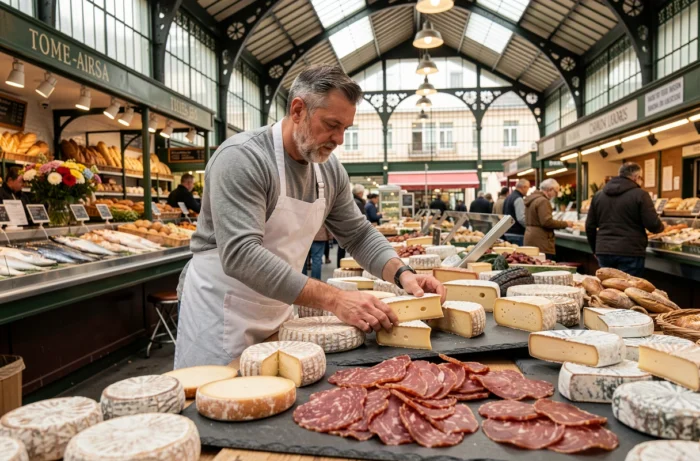
Covered markets, like those in the Ternes neighborhood or Saint-Martin, host vendors who are established year-round. You can find affineurs (cheese ripeners), butchers working with specific cuts, and fishmongers with regular deliveries. The advantage: you can return any open day and find the same vendor, building a relationship of trust.
Outdoor markets, however, operate on a different rhythm. The market on Boulevard de Belleville or the one along Boulevard Auguste-Blanqui in the 13th arrondissement attracts a mix of producers, resellers, and street food stalls. The culinary diversity is often more pronounced, with specialties from North Africa, Asia, or West Africa. For fresh products, it’s best to arrive early: the best stalls are cleared out before noon.
The case of organic markets in Paris
The organic market in Batignolles, in the 17th arrondissement, remains a benchmark for certified products. Each seller must present their organic certificate, making verification easier than elsewhere. You can find greengrocers from Île-de-France, goat cheese producers, and sourdough bakers.
The downside: prices are significantly higher than at a conventional market. For a weekly basket, the difference is notable. You can compensate by buying seasonal fruits and vegetables from an organic producer at the market, then supplementing with meat or fish at a covered market in the area.
Map of Parisian markets by arrondissement: neighborhoods to target
Rather than listing the markets one by one, here’s a reading grid by geographical area.
- Right Bank, northeast (10th, 11th, 20th): popular markets, accessible prices, strong presence of world products, lively atmosphere on Sunday mornings. The Belleville market and the one at Place d’Aligre are the most well-known
- Right Bank, west (8th, 16th, 17th): higher-end markets, selected producers, stalls of caterers and gourmet shops. The Ternes market and the President-Wilson market attract a demanding clientele
- Left Bank (5th, 6th, 13th, 14th): a good balance between neighborhood markets and organic markets. Boulevard Auguste-Blanqui hosts a conventional market and an organic market on different days
- Center and Marais (3rd, 4th): the covered market of Enfants-Rouges, the oldest in Paris, mixes fresh product stalls and on-site dining, ideal for a quick lunch
The best fresh products are not necessarily found in the most famous markets. A small neighborhood market in the 14th or 18th arrondissement, with three greengrocers and a cheesemonger, can offer superior quality compared to a large tourist market where product turnover is faster than freshness.
The best test remains to ask a simple question to the seller: where does this product come from, and when was it harvested? The answer, or lack thereof, says more than any label displayed at the stall.