Mounting a whitewall tire on a bobber and then navigating a winding country road in the rain is the kind of situation that quickly reveals whether the choice was made based on looks or rubber. For custom motorcycle tires, the challenge lies in balancing aesthetics and road grip. The style of the machine influences the tire profile, but it’s the actual use that makes the final decision.
Tread profile and pattern: what changes between a cruiser and a café racer
On a heavy cruiser loaded with torque, you mostly ride straight. The tire works on its central tread, and the pattern must evacuate water over a wide contact surface. A flat profile with deep longitudinal grooves does the job.
On a café racer, cornering behavior is more important. A rounder profile is sought, capable of quickly transitioning from one angle to another. The tread pattern then resembles what is found on a sport-touring tire, with chevron grooves that maintain grip while leaning.
The tire profile determines cornering behavior much more than the brand. A tire with too flat a sidewall on a café racer makes the bike sluggish to lean in. Conversely, a profile that is too round on a bagger increases straight-line braking distances because the contact surface with the ground decreases. To choose well among custom motorcycle tires, one must start with the machine’s profile above all.

Scrambler: the special case of mixed road and trail
Scramblers present a concrete problem: we want knobby tires for the look (and for dirt paths), but we ride over 80% on the road. A tire too off-road oriented vibrates on asphalt, wears out quickly, and degrades braking on dry surfaces.
The solution involves tires with shallow knobs, designed to maintain sufficient contact surface on the road. Metzeler, Pirelli, and Bridgestone offer references in this niche. Feedback varies on longevity depending on the dominant surface, but the 80/20 road-trail compromise remains the most suitable for daily use.
Load index and speed index on custom motorcycles: two markings often overlooked
We focus on the dimensions (width, aspect ratio, rim diameter) and forget the two numbers that follow. The load index and speed index are, however, engraved on the sidewall, just after the size.
- The load index indicates the maximum weight the tire can support. On a cruiser loaded with saddlebags, a passenger, and a top case, underestimating this index distorts the tire and degrades stability.
- The speed index corresponds to the maximum sustained speed. Fitting a tire with too low an index compared to the motorcycle’s capabilities is prohibited on the road and noted during technical inspections.
- The approved dimensions are listed in the manufacturer’s manual or on the registration certificate (section J). Deviating from this without validation can pose an insurance problem in case of an accident.
On customs, there is a strong temptation to switch to a wider tire for aesthetics. This is possible, but only if the rim can accommodate this width and the wheel arch allows enough clearance. A tire that brushes against the swingarm at the slightest pothole poses a real mechanical risk.
Tire compound: hard, soft, or bi-compound for custom use
The composition of the rubber is not a detail reserved for track riders. On a custom motorcycle used year-round, the choice of rubber directly affects the lifespan and grip in the rain.
A hard rubber extends the tire’s longevity but takes longer to warm up. When leaving the garage on a winter morning, grip remains low for the first few kilometers. A soft rubber grips quickly but wears out significantly faster, sometimes in just a few thousand kilometers on a highway trip.
Bi-compound: the most common compromise in custom
Michelin, Pirelli, and Dunlop offer custom tires in bi-compound rubber. The center of the tread is made of hard rubber (for longevity on straight roads), while the shoulders are made of softer rubber (for grip in corners).
This setup is suitable for the majority of custom road uses. We mostly ride straight, so the central part wears evenly. When leaning, the shoulders of the tire provide better grip than a tire made entirely of hard rubber.
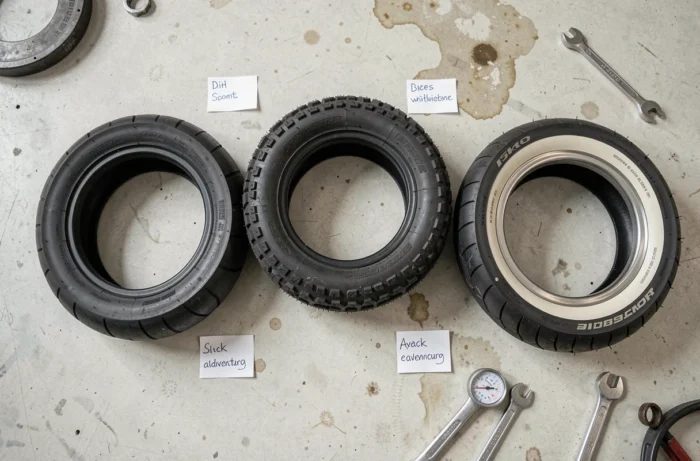
Radial or diagonal structure: how tire construction affects handling
The internal structure of the tire influences rigidity, comfort, and high-speed behavior. There are two families.
Diagonal (bias-ply) tires have carcass layers crossed at an angle. This construction is more flexible laterally, which suits heavy customs riding at moderate speeds. The majority of tires fitted as original equipment on cruisers and bobbers remain diagonal.
Radial tires, on the other hand, have layers perpendicular to the direction of travel. The result is better stability at high speeds and reduced heating. They are more commonly found on power cruisers and some café racers designed for a sportier use.
Mixing radial and diagonal tires on the same motorcycle is not recommended. The two structures do not deform in the same way, which creates an imbalance during braking and cornering.
European regulation and abrasion: a rising criterion
The European regulation 2024/1257 (Euro 7) now includes tire abrasion in the scope of non-exhaust emissions. Gradual compliance thresholds will come into effect starting in 2028, depending on the categories of tires.
For the custom motorcyclist, this means that manufacturers will reformulate their rubbers to reduce emitted microplastics. In the long term, some very soft references may disappear from the catalog or see their composition modified. This is a factor to keep in mind during the next tire change, especially if one is attached to a specific model.
Choosing a custom tire remains a trade-off between three axes: the visual appeal on the motorcycle, the expected road behavior, and the durability of the rubber. Starting from the actual riding style rather than the aesthetic catalog avoids most unpleasant surprises at the first wet corner.