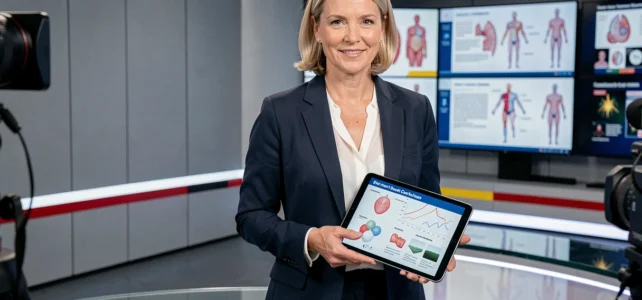
Medical television refers to an audiovisual device installed in waiting rooms of practices, clinics, or hospitals, broadcasting health content validated by professionals. In Belgium, where the digitalization of care has been accelerating for several years, this information channel holds a special place: it reaches the patient at the precise moment when they are available and receptive, just before their consultation.
Medical waiting room: why the screen changes the game
Digital competitors to paper posters are multiplying, but the waiting room remains a blind spot. Patients spend variable amounts of time there, often perceived as unproductive. A screen broadcasting tailored medical programs transforms this wait into a moment of passive learning.
Unlike an internet search where the patient chooses their sources (with the risk of encountering unverified content), medical television imposes an editorial filter. Topics are selected, speakers are identified, and the short format prevents drift towards sensationalism. Platforms like med-tv.be offer this type of programming specifically designed for Belgian care environments.
The mechanism is based on a simple principle: the repetition of short visual messages increases retention. A patient who sees a segment on diabetes screening or seasonal flu vaccination does not need to search for the information themselves. It reaches them in a context they already associate with medical trust.
Validated health information versus unfiltered online content
The question of the quality of health information is becoming increasingly pressing in Belgium. Social media and public video platforms are overflowing with medical content produced without any scientific oversight. Studies on the reliability of YouTube as a patient education source show concerning results: the majority of popular videos on certain conditions contain incomplete or misleading information.
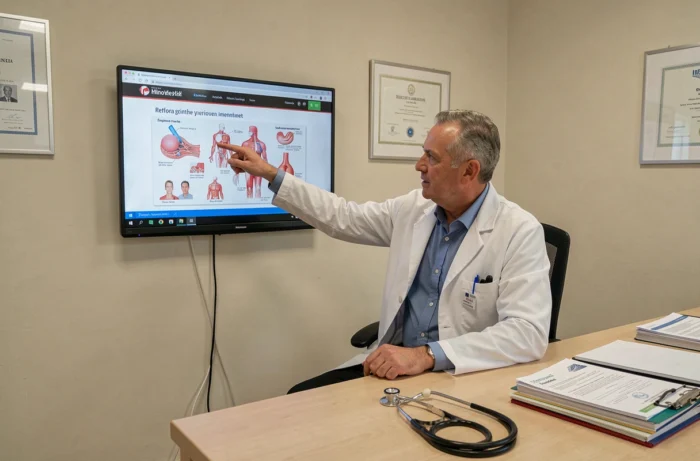
Medical television in the waiting room operates on the opposite principle. Each program undergoes editorial validation involving doctors or health institutions. The patient does not have to assess the credibility of the source, which eliminates a common cognitive bias: the tendency to believe the most engaging content rather than the most reliable.
What medical television covers better than the web
- Local prevention campaigns (colorectal cancer screening, mental health, seasonal vaccination), often drowned in the flow of social media but broadcast on loop on medical screens.
- Belgian regulatory developments regarding reimbursement or nomenclature, translated into accessible language for the patient.
- First aid gestures or lifestyle hygiene, presented in short video format, more effective than a brochure that no one reads.
This channel does not replace the consultation. It prepares for it. An informed patient asks more precise questions and better understands their doctor’s recommendations.
Medical television and the digitalization of care in Belgium: the regulatory context
Belgium is undergoing a phase of regulatory acceleration in the field of digital health. The royal decree establishing a general reference framework for remote care was published on April 7, 2025, laying the legal foundations for health services provided through information and communication technologies.
Since the summer of 2026, this dynamic has expanded: speech therapists are authorized to conduct video consultations starting September 1, 2026, a decision announced by Federal Health Minister Frank Vandenbroucke. Telemedicine no longer concerns only doctors, it extends to physiotherapists and midwives.
In this context, medical television in the waiting room represents a complementary link. It does not fall under telemedicine in the strict sense (no remote care act), but it participates in the same ecosystem: that of a health system that integrates digital technologies at every point of contact with the patient.
The patient remains the reference, not the technology
A recent opinion from the Belgian Medical Association reminds us of a fundamental ethical principle: the shift to digital should not become the default norm if the patient does not master it or does not wish for it. Digital information serves the patient, not the other way around.
This position directly applies to medical television. The screen in the waiting room requires no digital skills: no app to download, no account to create, no navigation. The content reaches the patient frictionlessly, making it a particularly suitable tool for audiences distanced from digital technology.

Perception of waiting and therapeutic education through the medical screen
Dynamic display in care settings acts on two simultaneous levers. The first is the reduction of the perception of waiting time. A patient watching a structured program feels they have waited less time than a patient facing a white wall or a pile of outdated magazines.
The second lever is therapeutic education. For patients with chronic diseases (diabetes, heart failure, hypertension), the repetition of targeted messages between two consultations reinforces adherence. The doctor then has a common base of knowledge to rely on during the consultation.
- A message on blood pressure self-monitoring seen in the waiting room prepares the dialogue on home monitoring.
- A segment on the side effects of a common treatment reduces anxiety and limits uncoordinated treatment discontinuation.
- A reminder of the warning signs of a serious condition encourages earlier consultation before the situation deteriorates.
Medical television neither replaces the doctor nor the pharmacist. It occupies a temporal and spatial niche that no one else exploits: the waiting minutes when the patient is already in a posture of medical trust. In Belgium, where the network of medical homes and group practices is densifying, this health information channel is set to generalize well beyond just hospitals.