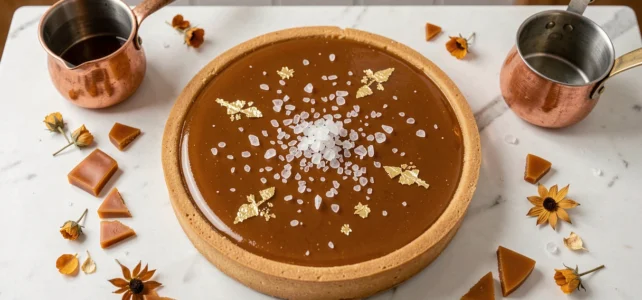
When looking for a quick dessert idea on a Sunday evening and stumbling upon a miso caramel recipe, you know that confectionery has changed its tune. Mademoiselle Caramel, a French blog dedicated to delicious recipes and tips, closely follows these developments. With new flavors, practical everyday recipes, and trends redefining caramel, the site offers a regular stream of content worth checking out.
Miso Caramel, Tahini, Espresso: The “Swalty” Wave Explained
Breton salted butter caramel has long dominated gourmet conversations in France. For the past few months, another family of flavors has been gaining traction: we’re talking about “swalty” profiles, a contraction of sweet, salty, and savory. The principle is to add an umami or roasted dimension to classic caramel.
In practice, this results in combinations like white miso caramel, tahini caramel (sesame paste), espresso caramel, or even naturally sweet versions with dates or honey. These recipes are not confined to gourmet restaurants. They can be found in artisanal spreads, pancake fillings, and even indulgent infusions.
To try at home, miso caramel is probably the most accessible. You replace part of the salted butter with a tablespoon of white miso at the end of cooking. The result brings a salty depth different from Guérande salt, with a slight fermented note that surprises at first taste and then becomes addictive. Following the news on Mademoiselle Caramel allows you to spot these types of recipes as soon as they are published.
Practical Robot Recipes: What the Blog Offers Daily
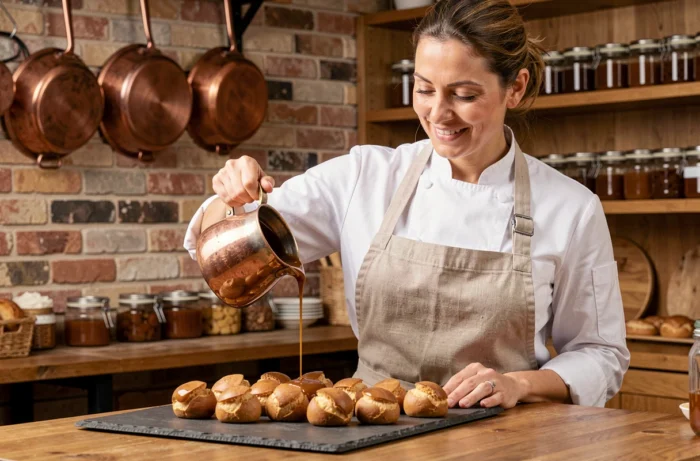
What sets Mademoiselle Caramel apart from many culinary blogs is the focus on quick preparation. Several recipes are designed for machines like Thermomix or Cookeo, with calibrated cooking times and precise settings.
For example, there are contents on cooking chickpeas in a pressure cooker with a chart according to the recipes, or steamed endives in the Cookeo. These are not “chef” recipes but weekday recipes, designed for people who cook between meetings or after picking up the kids.
The approach is the same for baking: express almond cake in the robot, light ladyfinger biscuits. Each recipe aims for a delicious result with minimal hassle. There are also guides on technical gestures like peeling chestnuts without struggle, a topic that comes up every autumn in searches.
Some Recurring Themes on the Blog
- Precise cooking times for everyday products (beef roast, chickpeas, endives), often in the form of comparative charts
- Revisited Norman and Breton recipes, like pork tenderloin with cider and apples, using local ingredients (butter, cider, buckwheat)
- Preparation in large quantities for freezing later, useful for organizing weekly meals without cooking every evening
Sugar-Free Confectionery and Functional Caramels: A Trend to Watch
The confectionery market is experiencing a subtle but significant shift. European manufacturers are now developing sugar-free caramels formulated with isomalt, a sweetener derived from beetroot. These products aim for a “tooth-friendly” positioning while maintaining the expected melting texture of caramel.
We are also seeing the emergence of so-called “functional” caramels: enriched with fiber, coffee-flavored for a slight caffeine boost, or combined with ingredients like lemon and ginger. The “Sweets Box” collection presented in 2026 illustrates this direction with sugar-free confectionery concepts designed for the industry but also influencing artisans.
For a blog like Mademoiselle Caramel, this trend opens up an interesting recipe territory. Adapting a homemade caramel recipe by replacing white sugar with honey or dates is already a step towards these “lighter” profiles. Feedback varies on this point, as the texture of a traditional sugar-free caramel remains difficult to reproduce in home cooking, but results improve with the right ingredients.
Homemade Caramel Spread: The Must-Try Star Product
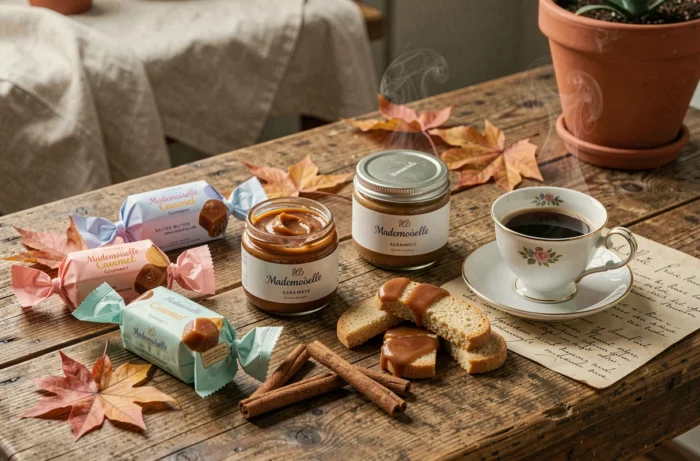
If we had to highlight a single product that encapsulates the world of Mademoiselle Caramel, it would be the spread. A homemade salted butter caramel spread can be prepared in under twenty minutes and requires only three basic ingredients: sugar, liquid cream, and semi-salted butter.
The key lies in the cooking of the dry caramel. You heat the sugar without water, stirring gently until it reaches a dark amber color. If it’s too light, the taste remains flat. If it’s too dark, bitterness dominates. You then deglaze with hot cream (watch out for splashes), and then incorporate the butter off the heat.
To vary, you can add a pinch of Guérande fleur de sel, a spoonful of tahini, or a splash of espresso. This type of content, with concrete variations and calibrated cooking tips, is the strength of a specialized gourmet blog. You end up with a product that has nothing to do with industrial spreads, where sugar and palm oil often make up the majority of the ingredients.
The Ingredients That Change Everything in a Caramel
- Breton semi-salted butter provides a rounder natural saltiness than salt added at the end of the recipe
- Whole cream (rather than light) ensures a creamy texture that holds on the spoon
- White miso or tahini transform a classic caramel into a product with complex notes, halfway between dessert and condiment
- Lemon zest (not juice) adds a freshness that balances the sugar without acidifying the preparation
Mademoiselle Caramel regularly publishes recipes that explore these combinations. The blog remains rooted in accessible cooking, with products found in supermarkets or gourmet shops, without professional equipment. It’s this grounded positioning, between grandma’s recipe and trends spotted among artisans, that makes you want to keep the address in your favorites.