In France, the proportion of people over 60 living alone has been increasing for several years. Public and associative initiatives are multiplying to recreate connections, but their formats, funding, and sustainability vary considerably. Behind the term “mutual aid,” the realities on the ground paint a more contrasting picture than it appears.
Inclusive housing for seniors: a legal framework in full reorganization
Inclusive housing is based on a simple principle: several people share a common living space while retaining private areas. For seniors, this model differs from traditional cohabitation by the presence of a social life project, sometimes coordinated by a facilitator or an association.
The press release from the National Disability Conference 2026 announces a three-year plan aimed at renovating these shared housing models, harmonizing their legal and financial frameworks, and simplifying relationships between stakeholders. This initiative concerns both people with disabilities and seniors experiencing loss of autonomy. The current framework, fragmented between departmental aids, packages allocated by ARS, and local subsidies, makes the creation of new projects slow and uncertain.
On partage-senior.net, several feedbacks illustrate the diversity of setups: managing associations, social landlords, local authorities. Project leaders regularly report difficulties in stabilizing their economic model once the start-up aid is exhausted.
Digital technology as a tool for collective organization
The digital aspect of inclusive housing remains poorly documented. The same report from the National Disability Conference indicates that 3.5 million euros were allocated in 2025 for digital works and equipment in inclusive housing, with a renewal planned for 2026. The goal is not limited to providing a tablet to each resident: it aims to facilitate daily coordination (shared planning, grocery management, connection with remote caregivers).
Field feedback on this point varies. Some housing setups report smooth adoption when human support is provided. Others find that the digital tool creates an additional burden for residents who are less comfortable with these technologies.
Intergenerational cohabitation: beyond the senior-student duo
The most well-known model pairs a senior homeowner with a student housed at a lower cost in exchange for services or companionship. This format has been working for years thanks to well-established associative networks. The novelty comes from projects that broaden the scope.
The Maison d’Aspasie, opened in 2023, brings together seniors, young people in professional integration, and families with children in the same building. Participation in communal life is expected but not mandatory. This nuance is structuring: it avoids the pitfall of an imposed activity program that ultimately discourages the most autonomous residents.
This type of place raises a question rarely addressed in practical guides: how to balance collective life without turning mutual aid into a social constraint? Successful models seem to rely on attractive common spaces (shared kitchen, garden, workshop) rather than a schedule of mandatory activities.
Local solidarity and local associative networks
Outside of housing initiatives, mutual aid among seniors is often organized at the neighborhood or municipal level. Several formats coexist:
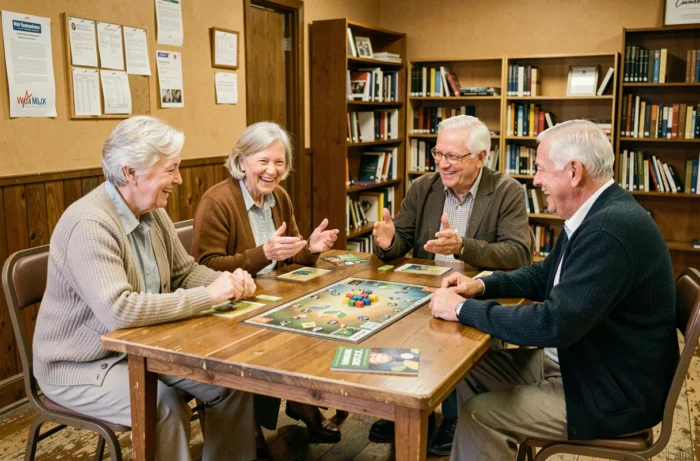
- Municipal senior clubs and centers, which offer regular activities (in Paris, the City counts 65 senior clubs spread across all districts, with free activities ranging from gentle gym to smartphone initiation).
- Active neighborhood networks, where volunteers provide small services (grocery shopping, accompanying to a medical appointment, daily phone calls) without heavy structure.
- Shared gardens and collective workshops, which create a regular opportunity for meeting around a concrete activity.
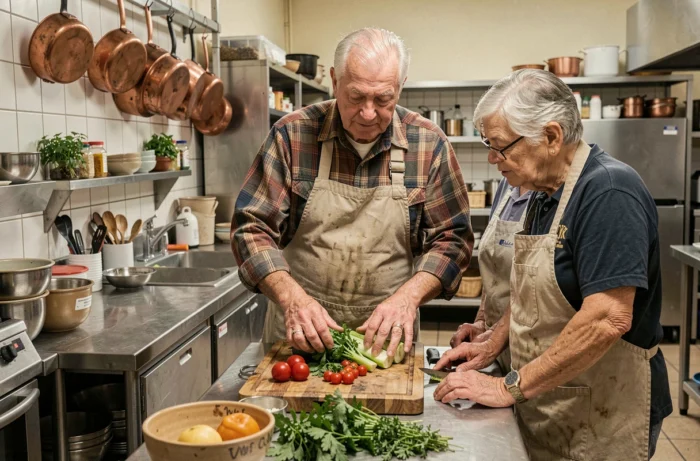
The common limitation of these initiatives lies in their dependence on a few driving volunteers. When these individuals move away, fall ill, or become exhausted, the mutual aid network can collapse within months. The communities that sustain these initiatives are generally those that fund a dedicated coordination position, even part-time.
Digital workshops: a lever for social connection under conditions
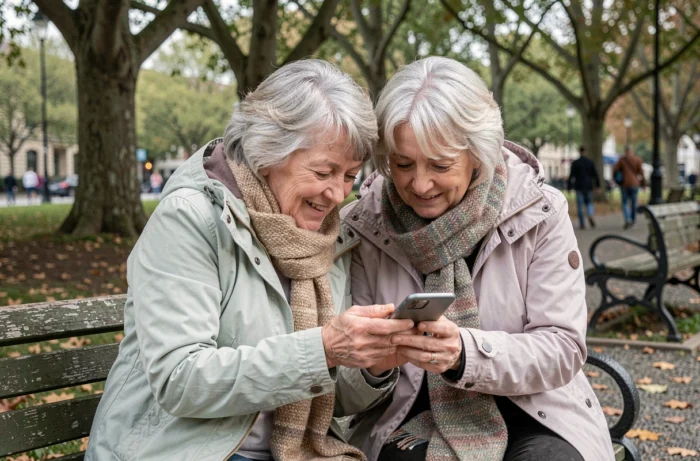
Digital initiation workshops are among the most requested activities in senior clubs. Learning to use messaging, make a video call, or navigate a public service website meets an immediate practical need. The side effect, often underestimated, is the creation of a peer group that meets weekly around a common topic.
The format works better when the facilitator is a trained senior rather than an external instructor. Peer-to-peer transmission reduces the discomfort associated with the feeling of “not being up to date” and fosters a dynamic of spontaneous mutual aid after the sessions.
Structural limitations of sharing initiatives among seniors
The proliferation of projects should not obscure several recurring vulnerabilities. Funding remains the critical point: start-up grants are relatively accessible, but long-term operation lacks viable economic models. Inclusive housing, intergenerational cohabitation, and local networks share this issue.
The question of mobility constitutes another blind spot. The most isolated seniors are often those who cannot travel to the club, shared garden, or digital workshop. Mobile services (mobile libraries, workshops at the foot of buildings, home visits) exist, but their territorial coverage remains very uneven, especially in rural areas.
Finally, the available data do not allow for precise measurement of the impact of these initiatives on the health or well-being of participants. Published evaluations most often rely on small-scale self-reported surveys. This lack of perspective makes it difficult to compare different models and complicates funding decisions.
Successful initiatives share a common trait: they start from a concrete use (a meal, a garden, a repair service) rather than an abstract goal of “social connection.” Mutual aid works when it meets an identified need, not when it is decreed by a program. This is probably the most consistent lesson from the field feedback accumulated in recent years.