
Zalando purchases its stock directly from brands or through authorized distributors, then resells it under its own name. This retail activity coexists with a marketplace where third-party sellers, called partners, offer their own items. Understanding this distinction is the first step in assessing the reliability of a pair of shoes before placing an order.
Zalando item or partner item: a separation that changes everything
On each product page, a note specifies the identity of the seller. When the item is sold and shipped by Zalando, the platform acts as a retailer: it has purchased the product, stores it in its warehouses, and takes responsibility for compliance. The risk of counterfeiting in this circuit remains marginal, as the supply chain goes through the official channels of the brands.
When the listing indicates a partner item, the seller is a third-party merchant. Zalando imposes admission criteria on these partners, but the quality control differs. A ruling from the Court of the European Union issued on September 3, 2025 (case T-348/23) has formally distinguished these two activities, requiring Zalando to clarify its role regarding third-party sellers.
For a buyer, this recent regulatory separation is not trivial: it determines the possible recourse in case of doubt about the authenticity of shoes on Zalando. Before placing any order, checking this note on the product page takes a few seconds and significantly reduces the risk.
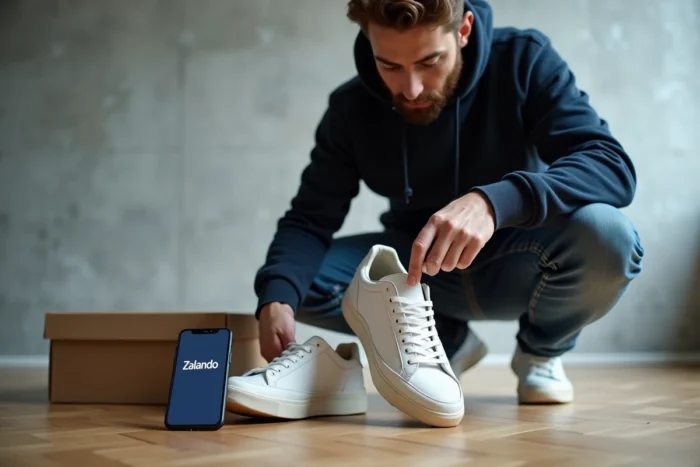
Spotting suspicious signs on the Zalando product page
Even on a reputable platform, carefully reading the product page remains a useful reflex. Several elements deserve particular attention.
- The displayed price: an abnormally low price compared to the brand’s catalog price, without mention of an official promotion, may signal a supply issue with a third-party partner.
- The photos: Zalando generally uses its own studio shots with a standardized neutral background. Photos that appear to be taken by hand or sourced from another site should raise alarms, especially for partner items.
- The technical description: an incomplete listing, without reference to the exact model, without mention of the material or country of manufacture, lacks transparency. Brands provide this information to their authorized distributors.
These checks do not guarantee authenticity on their own, but they filter out the least reliable listings even before placing an order.
Physical inspection of shoes upon receipt
Box and labeling
The original box of an authentic pair contains a SKU code or barcode corresponding to the exact model ordered. This code is also found on the interior label of the shoe. If the two do not match, doubt is legitimate.
Brands like Nike, Adidas, or Asics use interior labels with very specific fonts, character sizes, and placements. A poorly centered label, printed with smudged ink, or stuck on crookedly is a warning sign.
Finishes and materials
Regular stitching, clean bonding between the sole and upper, and the absence of visible glue marks are indicators of controlled manufacturing. On specialized forums, buyers have reported receiving pairs via online platforms that exhibited irregular stitching or slightly misaligned logos, which prompted immediate returns.
The smell can also serve as an indicator. An authentic new pair emits a scent of new materials (leather, technical fabric, rubber). A strong and persistent chemical smell, like solvent, is often associated with inferior quality materials.
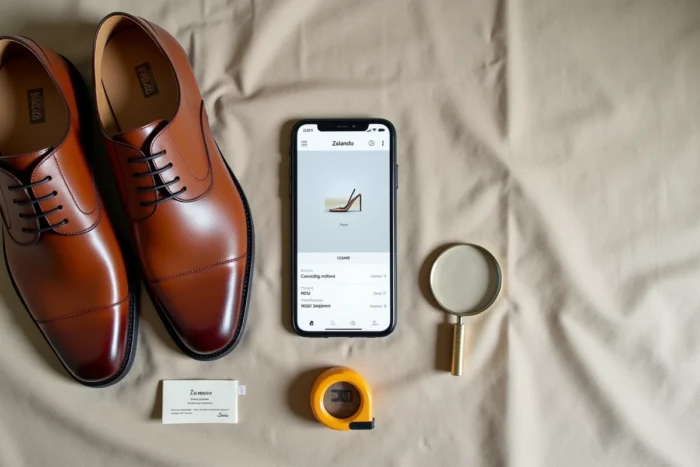
External authentication services for sneakers
When doubt persists after visual inspection, specialized third-party services can help make a determination. Applications like LegitApp offer authentication through photos analyzed by experts and artificial intelligence. This type of service covers the most counterfeited sneakers and designer items.
The principle is simple: the user photographs the pair from several required angles, then receives a verdict along with a certificate. These services are not free, but their cost remains low compared to that of a counterfeit high-end pair.
This recourse makes the most sense for models with high resale value (limited editions, collaborations) where counterfeiting is most prevalent. For a common pair purchased directly from Zalando as a retailer, the risk does not always justify this expense.
Fake Zalando sites: a trap distinct from the official platform
A risk often confused with the issue of product authenticity concerns clone sites that imitate Zalando’s visual identity. Platforms presenting themselves under similar names, notably “Zalando Privé” with no link to the brand, have been reported as fraudulent by specialized observers.
These sites use generic scripts, lack any verifiable legal notice, and offer unrealistic prices. Any order placed on such sites exposes the buyer to receiving counterfeits or complete non-delivery.
To ensure you are on the correct site, checking the URL remains the most reliable precaution: only zalando.fr (and its official national variations) corresponds to the legitimate platform. A quick search of the domain name on a site verification tool can clear up doubts in seconds.
The 14-day right of withdrawal and Zalando’s extended return policy provide a final safety net. If, after receipt and inspection, a pair seems questionable, free returns allow for a refund without having to prove counterfeiting. This option turns every purchase into a concrete evaluation period, provided the shoes are not worn beyond a simple try-on.