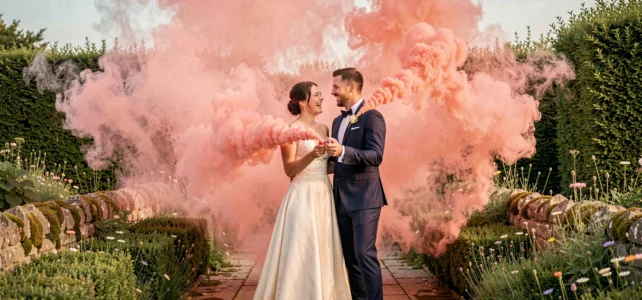
Wedding smoke bombs are classified in the same pyrotechnic categories as consumer fireworks. This regulatory reality, often overlooked when purchasing online, nonetheless determines the conditions of use, the authorized locations, and the precautions to be taken on the big day. Understanding this framework before choosing a product helps avoid unpleasant surprises, from insufficient smoke to the venue manager’s refusal.
Pyrotechnic classification of wedding smoke bombs: what the categories actually change
European regulations classify most smoke bombs sold for weddings in category F1 or T1. Category F1 includes small entertainment fireworks, sold year-round and accessible without training. Category T1 pertains to technical or stage pyrotechnics, with similar constraints but usage oriented towards visual effects.
This classification is not just an administrative formality. It determines the minimum age of the buyer, the authorized sales method, and especially the use in ERP (establishments open to the public), meaning almost all reception halls, tents, and restaurants.
| Criterion | Category F1 | Category T1 |
|---|---|---|
| Main use | Public entertainment | Stage / technical effect |
| Sales | All year round, without seasonal restrictions | All year round, specialized circuit |
| Place of use in ERP | Subject to manager’s authorization | Subject to manager’s authorization |
| Safety obligation | Identical to classic fireworks | Identical to classic fireworks |
The key point to remember: a smoke bomb marketed as “photo” or “festive” is still subject to the same safety obligations as a classic firework. Colorful packaging and mentions of “wedding special” do not change anything from a regulatory standpoint.
To explore the different options available, couples preparing their reception can consult the references of wedding smoke bombs on 123 Mariages to compare the formats and durations offered by suppliers.
Indoor or outdoor smoke bombs: two contexts, two levels of risk
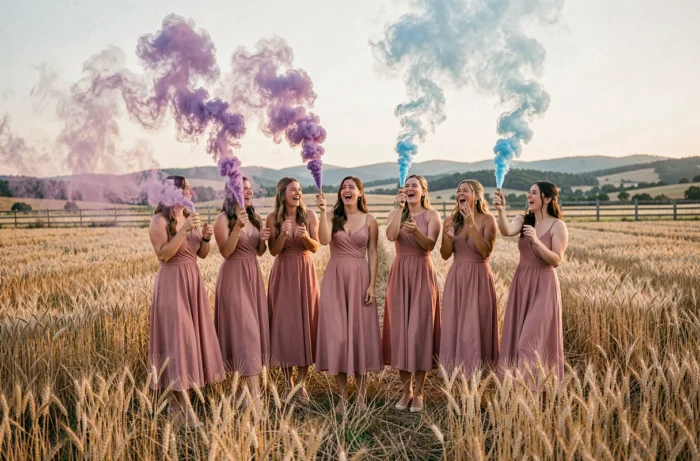
The indoor/outdoor distinction is the factor that weighs most heavily on feasibility. Outdoors (garden, estate courtyard, field), use remains relatively simple to organize. The smoke disperses naturally and the risk of triggering a fire alarm is nil.
Indoors, the situation changes radically. From 2024-2025, fire safety experts for ERP remind that festive pyrotechnic products, including sparklers and fountains often associated with smoke bombs, are formally considered as sources of ignition under ERP fire regulations. Some venues and restaurants now prohibit or regulate their use much more strictly.
What the venue manager may require
- A prior declaration mentioning the exact type of product, its pyrotechnic category, and the expected quantity
- The designation of a person responsible for ignition, distinct from the couple (photographer, trained witness, service provider)
- The presence of a fire extinguisher in immediate proximity and the clearance of emergency exit areas
Contacting the venue manager at least three weeks before the date allows for verification of whether use is authorized and under what conditions. A late refusal forces improvisation, which rarely yields good photographic results.
Torch, pot, or pin: which format for which photographic effect
The choice of format directly determines the smoke density, the duration of the effect, and the ease of handling. The three main formats do not offer the same result in photos.
Torch smoke bombs are held in hand and produce directed smoke, easy to orient for the photographer. This format remains the most used for couple portraits as it allows control over the direction of the plume. Handling is intuitive, even for people who have never handled a pyrotechnic product.
Pot smoke bombs are placed on the ground. They release a wider cloud, suitable for group photos or wide shots. However, their fixed position makes framing less flexible if the wind changes.
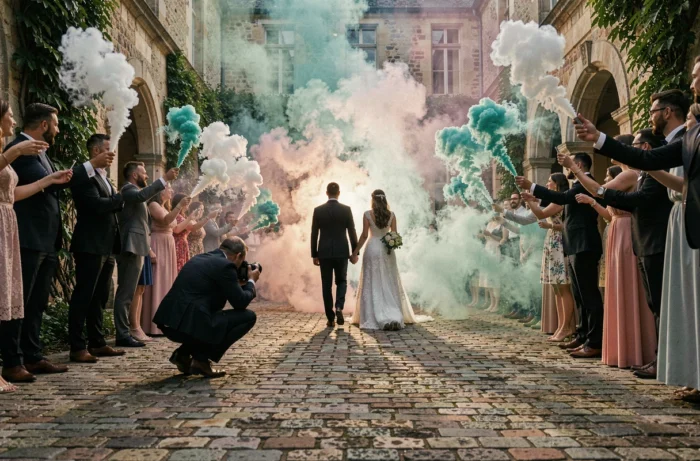
Pin models are activated by pulling, without flame or friction. The absence of an open flame reduces the risk of burns, making them suitable for contexts where several guests participate simultaneously (honor guard, ceremony exit).
Parameters to discuss with your photographer
- The duration of the effect: smoke that is too short leaves little room for adjustments, while smoke that is too long saturates the background
- The color relative to the decor: a white smoke bomb against a white wall disappears, a red smoke bomb against greenery creates a sharp contrast
- The wind: even a light breeze moves the plume in seconds, the photographer must anticipate the wind direction before ignition
- The number of smoke bombs active simultaneously: beyond three or four, the smoke becomes opaque and masks faces
Coordination with the photographer remains the most underestimated factor. A professional experienced with smoke bombs will know the precise moment to ignite to capture the right smoke density, neither too thin nor too thick.
Safety precautions for a wedding smoke bomb without incident
Smoke bombs produce heat, even those labeled “cold.” Holding the smoke bomb with arms extended and pointed downwards limits the risk of burns to hands and face. Loose clothing, veils, and trains present a risk of snagging with the hot smoke: ensure a minimum distance between the product and the fabric.
The ground matters too. On dry grass in summer, a pot placed directly can cause a localized fire. Placing the smoke bomb on a mineral surface (slab, gravel, metal tray) eliminates this risk. After use, never throw a still-hot smoke bomb in a trash can: let it cool for several minutes on a non-flammable surface.
Children and animals present at the reception should be kept away from the usage area. The smoke, even non-toxic according to the manufacturer, can cause respiratory discomfort in sensitive or asthmatic individuals.
The regulatory framework, the product format, and coordination with the photographer form an inseparable triptych. Checking the pyrotechnic category on the packaging, obtaining written consent from the venue manager, and conducting a timed trial with the photographer the day before or the morning of the wedding remains the most reliable method for achieving successful photos without incident.