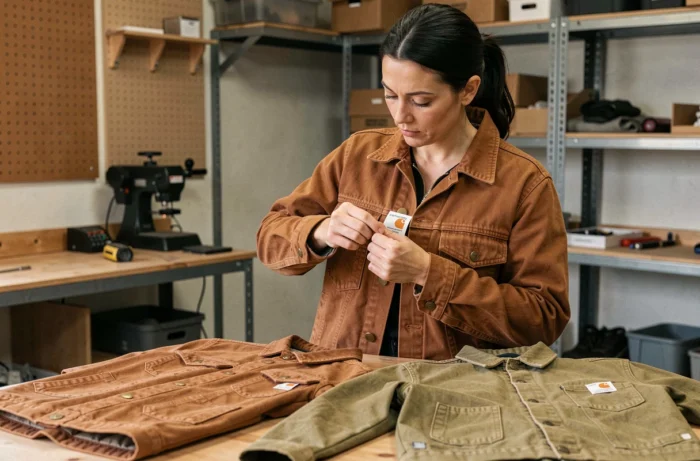
Counterfeiting Carhartt is no longer limited to poorly sewn patches on thin canvas jackets. Current replicas reproduce the embroidery, imitate the weight of duck canvas, and even copy the style codes on care labels. Distinguishing a genuine Carhartt requires cross-referencing several physical and contextual clues, rather than relying on a single detail.
GPSR Regulation and Carhartt Labeling: A Filter That Fakes Can’t Pass
Since May 2026, Carhartt WIP has been applying the European General Product Safety Regulation (GPSR). Each item distributed in Europe must carry precise regulatory information: manufacturer’s address, safety instructions, and identification of the responsible party on the European market.
Counterfeits almost systematically ignore this regulatory layer. On a recent item, the total absence of GPSR mention or an inconsistent address (nonexistent city, incorrect postal code) is a strong signal. This is not an isolated proof, but when combined with other anomalies, it guides the diagnosis.
For Carhartt USA (workwear) items, the logic is similar: compliance labels for American standards (ANSI, NFPA for FR ranges) follow a stable format. A garment claiming to belong to the flame-resistant range without clear normative mention is suspicious. We recommend checking the Chercher site to recognize authentic quality to compare label formats by range and period.
Engraved Buttons and Carhartt Hardware: The Details Replicas Miss
Competing articles extensively detail woven patches and embroidered logos. We observe that hardware remains the most frequent weak point of counterfeits, even on high-end copies.
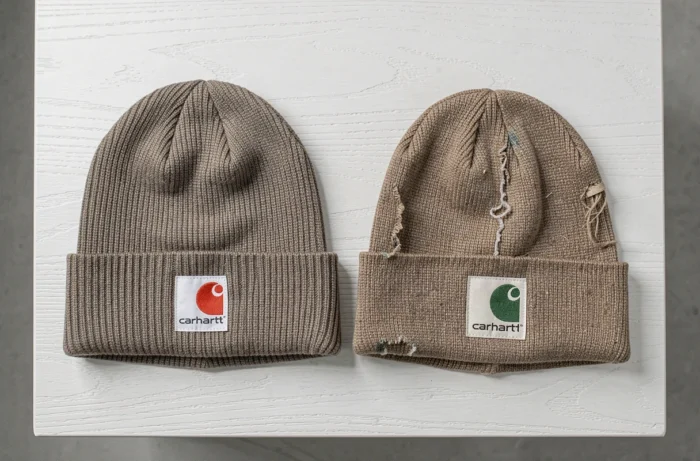
Carhartt metal buttons feature raised engraving, never a flat print. On an authentic Detroit Jacket or chore coat, the name “Carhartt” is stamped into the metal with a depth that is perceptible to the touch. Zippers are generally branded YKK or Ideal on workwear items. A zipper without branding or bearing a generic name deserves attention.
Rivets follow the same logic. On double knee pants, they are heat-set and bonded to the fabric. A counterfeit often uses glued or improperly pressed rivets that turn under the fingers.
- Main button: raised engraving of “Carhartt,” not recessed or printed, with a clean edge without metal burrs
- Zipper: visible YKK or Ideal marking on the slider, pull tab proportionate to the garment’s gauge
- Rivets (pants, overalls): fixed to the touch, slightly domed head, regular alignment on stress points
- Snaps (lined jackets): firm closure with a click, no lateral play
Style Code and Care Label: The Cross-Referencing That Cuts Through
Each Carhartt item carries a style code that corresponds to a referenced model. On the care label, this code usually appears as an alphanumeric sequence. This code can be verified on the official Carhartt website or in archived catalogs.
A counterfeit often displays a non-existent style code or a code that does not correspond to the type of garment. A cargo pant bearing the code of an insulated jacket immediately betrays the copy. We recommend systematically checking this number before any second-hand purchase.
The care label itself provides clues. On an authentic Carhartt, the holographic band appears on many items produced since the 2000s. Its absence is not disqualifying on vintage items from before, but on a piece allegedly recent, it is a red flag.

The typography on the label is consistent, with no variation in thickness between lines. Fakes often display irregular line spacing, slightly blurred characters, or a font that does not match the Carhartt standard for the period.
Provenance and Sales Context: The Filter That Visual Guides Overlook
Visual authentication alone is no longer sufficient. Counterfeits circulate through marketplaces, social media accounts, and merchant sites whose domain names mimic that of Carhartt. An abnormally low price on an item presented as new remains the most reliable signal even before examining the garment.
A site selling new Detroit Jackets for a third of the catalog price is a source of counterfeits, regardless of the care taken with the photos. Rights holders can request the removal of these listings and ask customs to intercept the goods, but the volume of counterfeits in circulation remains considerable.
For purchases in physical thrift stores or garage sales, cross-referencing remains the strongest method:
- Check the style code on the care label and cross-reference it with the announced model
- Examine the hardware (buttons, zippers, rivets) before even looking at the outer patch
- Check the consistency between the indicated size, the sizing system (W x L for USA workwear, European sizes for WIP), and the actual dimensions of the garment
- On a recent piece, look for GPSR mentions on the inner label
Automated authentication services that combine AI verification, label comparison, and human checks confirm this approach: no isolated criterion is sufficient; it is the accumulation of consistent clues that validates authenticity. An item that passes each filter individually but fails on a single point deserves a thorough examination rather than an impulsive purchase.