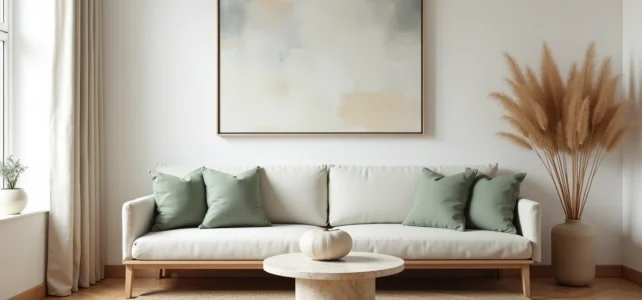
A repositioned sofa, a wall repainted in a bolder shade, a replaced light fixture: sometimes three actions are enough to change the perception of an entire room. Current decor trends do not require tearing everything down to rebuild. Instead, they offer precise, often low-cost levers that transform the ambiance of an interior without heavy renovations.
Modular furniture: decor that adapts to your daily uses
Have you noticed that a living room rarely serves just one purpose? We work there, we eat there, we host friends there. Fixed furniture, designed for a single use, creates blockages in circulation and in the organization of the day.
The answer lies in modular furniture designed for multiple uses. A coffee table that lifts to become a desk. An entry bench that incorporates storage. A low shelf on wheels that separates two areas without a wall. The idea is no longer to decorate for the sake of decoration, but to adapt the space to what we actually do there.
This shift has a name in decor vocabulary: daily adaptability. Where previous trends emphasized appearance, this one places function at the center. A piece of furniture that only serves to be beautiful ends up being a hindrance. A piece that transforms according to the time of day frees up space and simplifies life.
For those looking to explore this approach further, iDéco Maison’s decor selections gather pieces that illustrate this logic of flexibility applied to the living room, kitchen, or bedroom.
Natural materials and the end of polished concrete: what’s changing on surfaces
Polished concrete has long embodied modern interiors. Smooth gray floors, mineral countertops, walls coated in cool tones. This aesthetic is now receding in favor of finishes perceived as more authentic.
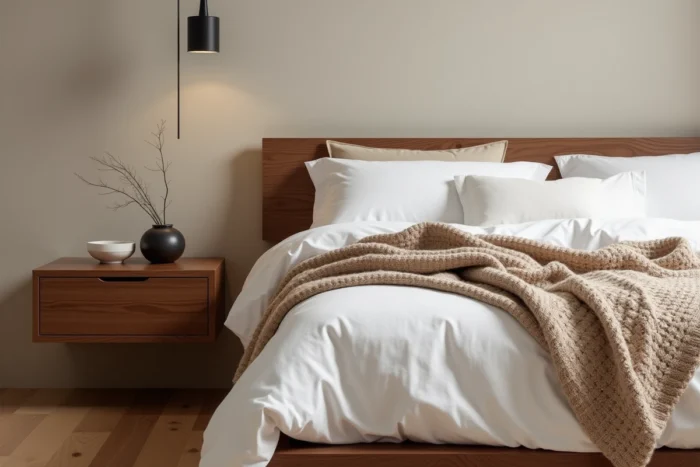
Natural materials are replacing industrial finishes in renovation choices. Raw wood, reconstituted stone, terracotta, linen on walls: these surfaces bring variations in texture that polished concrete did not offer. Each plank of wood, each tile of terracotta presents slight irregularities that add depth to a room.
This change is not just about appearance. Natural materials also contribute to better regulation of indoor humidity and a more pronounced acoustic comfort. A solid wood floor absorbs more sound than a polished concrete surface.
Which materials to favor in the kitchen and living room
In the kitchen, terracotta is making a strong comeback for floors. Its resistance to wear and warm hues (ochre, brick red, sand) create an ambiance that standard gray tiles do not produce.
In the living room, light wood paired with plant fiber textiles (jute, linen, thick cotton) provides a soft and bright base. The idea is not to coordinate everything in the same shade, but to play with contrasts in grain: smooth against rough, matte against satin.
Colored doors and accent walls: daring color without repainting everything
Repainting four walls of a room takes time, budget, and a certain confidence in choosing the shade. Painting just one door, however, takes half a day and costs the price of a can of paint.
Colored doors are becoming a decor lever in their own right. We’re talking about deep shades (fir green, midnight blue, terracotta) or natural hues (clay, sage, soft mustard) that contrast with light walls. The contrast draws the eye and structures the space without touching the furniture.
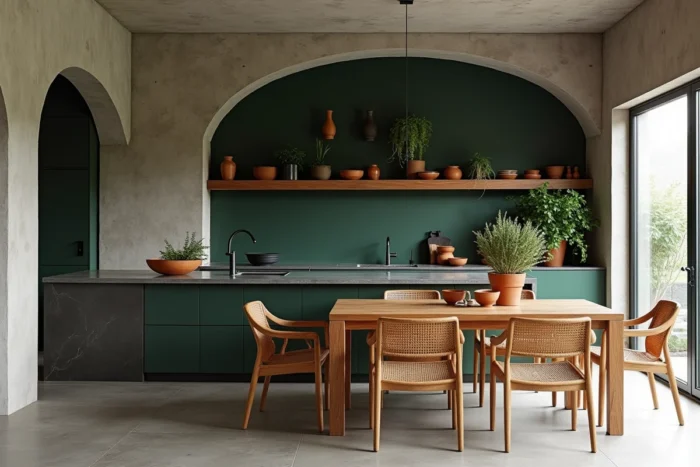
An accent wall works on the same principle. Rather than saturating an entire room, one chooses a single wall, the one that is most visible upon entering, and gives it a more assertive color. The rest remains neutral.
- In the entryway, a door painted in petrol blue creates an immediate focal point without altering the rest of the hallway.
- In a bedroom, a headboard wall in olive green adds depth without visually reducing the space.
- In a living room, a terracotta hue on the fireplace or in a recess is enough to warm the overall ambiance.
The advantage of this approach: it is reversible. If the color becomes tiresome after two years, repainting just one wall or one door is manageable.
Sensory decor: going beyond the visual to consider the overall ambiance
The least visible trend (in the literal sense) concerns what we feel in a room, not just what we see. Interiors are leaning towards more sensory and immersive atmospheres, where light, scents, and textures to the touch matter as much as colors.
Concretely, this translates into simple choices:
- Replacing a single ceiling light with multiple light sources (table lamp, wall sconce, discreet string lights) to modulate lighting according to the time of day.
- Incorporating varied textiles to the touch: a thick wool throw on a smooth leather sofa, corduroy cushions on a linen seat.
- Choosing candles or diffusers whose scent corresponds to the use of the room (woody notes in an office, citrus in a kitchen).
This is not a furniture revolution. It’s a work on the sensory layers that overlap in the same space. The eye perceives colors and shapes, but the body also registers the warmth of lighting, the softness of a fabric underhand, the coolness of a stone floor.
Craftsmanship and traceability: the criteria that weigh in decor choices
This shift towards the sensory is accompanied by an increased demand for the provenance of objects. Proven durability becomes a credibility criterion for decorative pieces: source of materials, reparability, transport impact. Attentive buyers no longer settle for an “eco-responsible” label displayed without details.
Favoring a stoneware vase made by a local workshop, a wooden table whose essence and origin are known, or a textile woven in an identifiable short circuit contributes to this logic of transparency. Interior decoration aligns here with a broader trend: we want to know what we bring into our homes, not just what it looks like.
Adapting your interior to current trends does not mean following all directions at once. Just one of these axes (modular, natural materials, targeted color, or sensory ambiance) is enough to produce a noticeable change. The most effective approach is to start with the room that annoys you the most and apply a precise action there rather than spreading efforts throughout the entire house.