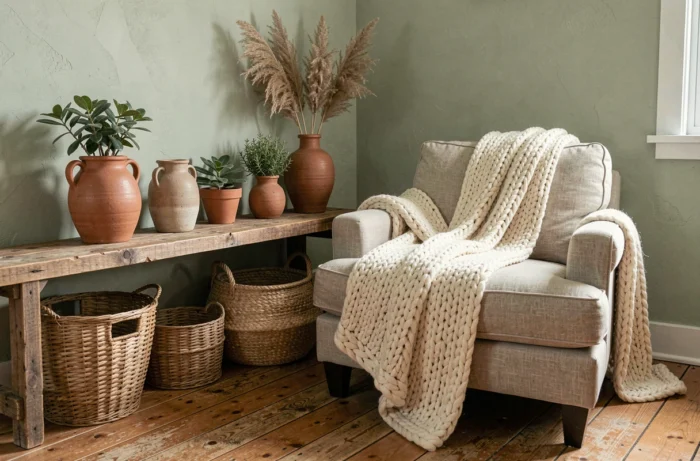
Handcrafted interior decoration is not just about placing a stoneware vase on a shelf. Behind the term “handmade” lie technical choices of materials, finishing constraints, and traceability criteria that determine the durability and coherence of a space. For several seasons, we have observed a convergence between aesthetic demands and rigor regarding the origin of pieces, driven by the warm minimalism movement.
REACH restriction on formaldehyde: what it changes for handcrafted furniture
Since August 6, 2026, the European REACH regulation imposes a restriction on formaldehyde emissions in furniture and adhesives. This regulatory change directly affects artisans who use reconstituted wood panels, glues, or varnishes in their creations.
For cabinetmakers and carpenters working with raw solid wood without composite panels, the impact remains limited. Unbonded oak, walnut, or ash are not subject to these thresholds. However, creators who assemble plywood, MDF, or use industrial lacquers must now verify the compliance of each batch of raw material.
We recommend systematically asking the manufacturer for a technical sheet specifying the type of glue used and its emission classification. A handcrafted piece made with low-emission vinyl glues or natural oils (linseed, tung) stands out clearly from a “handcrafted” item assembled with standard adhesives. This difference is not visible, but it is literally breathed in. Artisans listed on la-maison-de-daniel.fr specifically favor these finishes based on natural products.
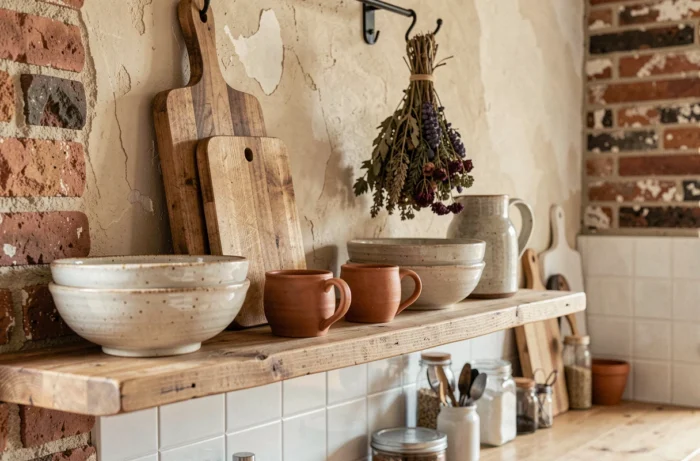
Warm minimalism and handcrafted decoration: a technical shift, not decorative
Warm minimalism, as it is shaping up in 2026, is not just a simple return to beige tones. It is a structured approach that combines organic curves, natural woods, and ambient light to create clean spaces without coldness. Craftsmanship plays a precise role here: to bring texture and irregularity that are lacking in the straight lines of classic minimalism.
In practical terms, this translates into specific material choices. A hand-turned ceramic light fixture diffuses light differently from a molded lampshade: the micro-variations in thickness create subtle shadow areas. A hand-planed wooden table retains a visible grain that industrial sanding erases.
Materials to favor for a warm, durable interior
- Stoneware and high-temperature glazed earthenware, whose resistance to thermal shock exceeds that of low-temperature fired ceramics
- Linens and hemp woven in France, which offer superior longevity compared to imported cottons due to the length of their fibers
- Locally sourced hardwoods (oak, beech, cherry) that are naturally dried, more dimensionally stable than woods dried in rapid kilns
- Cold-hammered metal (brass, copper), whose intentional deformations mask micro-scratches from use
The common point of these materials: their patina improves with time instead of degrading. A piece made of glazed stoneware or raw brass gains character after several years of use, whereas an industrial equivalent that is painted or chrome-plated shows its limits.
Traceability of handcrafted decorative objects: the criteria that matter
The origin and traceability of materials have become as crucial as appearance in the selection criteria. In 2026, the ability to repair and the environmental impact of the complete life cycle of an object weigh in on the purchasing decision.
A serious artisan documents the origin of their raw materials. For a wooden piece, this means knowing the species, the cutting region, and the drying method. For ceramics, the composition of the clay and the type of firing. A traceable object from raw material to finish is not a luxury: it is the condition for ensuring its future reparability.
Checking the authenticity of a handcrafted piece
Several checkpoints allow one to distinguish a truly handmade production from a semi-industrial production labeled as “handcrafted”:
- Slight asymmetries on a turned ceramic (variable thickness of the edge, fingerprints under the glaze) are a guarantee of authenticity
- On a wooden piece, traditional joinery (mortise and tenon, dovetail) visible when flipping the piece signals cabinetmaking work
- The presence of a signature or a stamp from the artisan, sometimes accompanied by a serial number on small productions

Revisited Art Deco and handcrafted pieces: combining styles without a taste fault
The return of Art Deco in a modernized version, with more subdued geometries and deep colors, opens an interesting field for craftsmanship. The geometric lines of this style pair well with handmade objects, provided a rule of proportion is respected.
Limiting handcrafted pieces to two or three per visible space avoids the “designer boutique” effect. A blown glass vase placed on an Art Deco console creates a dialogue between geometric rigor and organic irregularity. Multiplying objects in the same visual field cancels this contrast effect.
The choice of colors is as important as the shapes. The deep shades (fir green, midnight blue, burgundy) typical of contemporary Art Deco highlight raw materials. A broken white stoneware bowl stands out more against a dark background than it would against a light wall.
Handcrafted decoration benefits from being treated as a technical choice as much as an aesthetic one. Checking material compliance, demanding traceability, selecting pieces whose patina ages well: these reflexes transform a decorative purchase into a sustainable investment for the home.