
Declaring your attic to the tax authorities is not just about adding square meters to a form. What triggers the tax obligation is a change in the housing’s consistency: an uninhabitable space transformed into a habitable area. The distinction is technical, and declaration errors are less about forgetting than about confusing the different areas to report and the deadlines to respect.
Taxable habitable area and floor area: two calculations not to confuse
The main pitfall when declaring converted attics lies in the coexistence of several definitions of area. The floor area is used for urban planning (building permits, prior declarations). The taxable habitable area is used to calculate the cadastral rental value, thus affecting property tax and the residual housing tax on secondary residences.
| Type of area | Usage | Minimum height considered | Includes stairs? |
|---|---|---|---|
| Floor area | Urban planning authorization | No height threshold in itself (deducted above 1.80 m for certain calculations) | Not deducted |
| Habitable area (taxable) | Cadastral rental value, local taxes | Parts under 1.80 m excluded | Excluded |
| Carrez area | Co-ownership sale | Parts under 1.80 m excluded | Excluded |
In practice, areas of the attic under 1.80 m in height do not count towards the taxable habitable area. A mansard attic can thus show a floor area significantly greater than the habitable area declared to the tax authorities. Reporting the wrong value artificially inflates the cadastral rental value and, consequently, the amount of local taxes.
Knowing the steps to declare your attic first requires accurately measuring each zone while distinguishing these definitions.
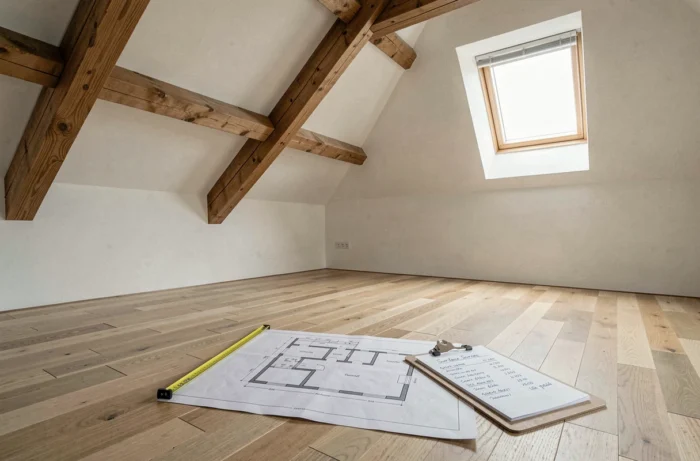
Tax declaration of attics: the 90-day deadline after completion of work
The 90-day deadline starts from the actual completion of the work, not from the date of the building permit or the acceptance of the site by the contractor. This distinction has direct consequences.
A late submission can result in losing the benefit of the temporary property tax exemption granted for new constructions or additions of habitable area. The tax administration considers the completion date as the starting point, and a delay of a few weeks is enough to push the exemption back a whole year.
What the form actually expects
Since 2023, the declaration mostly goes through the online service “Manage my real estate” on impots.gouv.fr. The old paper form H1 (model 6650) remains usable in certain situations, but the dematerialized route via the personal space is now the norm.
The service requires reporting several types of areas, which generates confusion:
- The total area of the property after work, including the newly converted attic
- The area of the main rooms (living room, bedrooms) and annexes (hallway, bathroom), distinguishing below or above 1.80 m
- The number of rooms in the dwelling, which changes if the attic adds one or more rooms in the fiscal sense
Each field corresponds to a parameter of the cadastral rental value. An error in the distribution of areas between main rooms and annexes alters the weighting coefficient applied to the calculation.
Property tax and converted attics: temporary exemption and reassessment
Converting lost attics into habitable space creates a new area in fiscal terms. This creation entitles, under certain conditions, to a property tax exemption for two years on the newly constructed part. The mechanism applies to new constructions, reconstructions, and construction additions.
However, this exemption is not automatic. It requires that the declaration has been submitted within the 90-day deadline and that the municipality has not decided to eliminate its share. Some local authorities have voted to partially or completely abolish this exemption.
Impact on long-term rental value
Beyond the temporary exemption, the reassessment is permanent. The cadastral rental value of the property increases proportionally to the added habitable area. A modest-sized attic will have a limited impact. A conversion that adds the equivalent of a full floor can significantly increase the property tax.
The development tax, distinct from the property tax, also applies to areas created when obtaining urban planning authorization. It is calculated on the floor area (not the habitable area), which can represent an amount higher than anticipated for a mansard attic.

Concrete risks of not declaring converted attics to the tax authorities
Not declaring your converted attic exposes you to several types of cumulative consequences:
- A tax adjustment with back taxes on property and housing for non-prescribed years, increased by late penalties
- A problem when selling the property: the gap between the declared area and the actual area can lead to price renegotiation or a dispute with the buyer
- In the event of a disaster, the insurer may contest coverage if the converted attic has not been subject to any urban planning authorization or tax declaration
The insurance risk is often underestimated compared to the tax risk. Water damage in undeclared attics can lead to a complete denial of compensation.
The tax declaration of attics relies on two key data points to master: the habitable area under 1.80 m excluded from the calculation, and the 90-day deadline after actual completion. Everything else – online form, temporary exemption, impact on property tax – stems from these two parameters being correctly reported.